ESSAY
Autonomous Financial Institutions: Why 2026 Is the Inflection Point
Introduction
On the operating-leverage problem at the GP layer, why institutional real estate becomes computable before other private asset classes, and what new graduates entering institutional capital should bet on.
In 2025 I gave a talk at Harvard arguing that 2026 would be the year autonomous financial institutions stopped being a thesis and started being a structural fact. The cost of compute, the capability of foundation models, and the engineering work to ground them in spreadsheet-native financial structure had finally converged.
The talk is below. This essay is the written version — sharper, with the references and figures that a stage doesn't accommodate.
The argument has three parts, plus three takeaways and one open question I do not have a clean answer to. The throughline is the one Apers was founded on: capital, like water, finds the most efficient layer. The most efficient layer in 2026 is not 4,000 analysts at Blackstone. It is a small team running models that think.
The Operating-Leverage Problem
Start with first principles. A private equity firm raises capital, charges a fee, hires people to find and execute deals, and returns capital with a promote if the fund performs. A $2 billion fund at standard 2/20 terms supports roughly 30 people. The labor is the firm.
That labor is also the problem.
Labor is largely fixed. You hire analysts in good years, and you cannot fire them quickly enough in bad years. Compute, on the other hand, is on-demand. A 2,000-person firm in 2020 looked lean against a low-cap-rate, capital-flooded environment. The same firm in 2025 looks bloated against a vacancy crisis and stagnant fee revenue. The operating leverage cuts both ways — and structurally it cuts harder against the GP than against the LP allocating the capital.
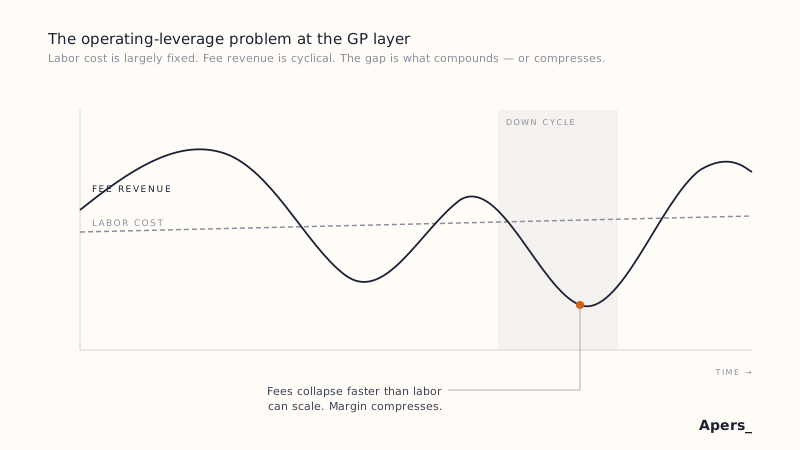
This is the backward economics most LPs are insulated from. The LP allocates 5–10% of a portfolio to real estate and pays roughly 2/20 to get exposure. The GP — Blackstone, Brookfield, or a $1B boutique I might start tomorrow — takes the operational risk of building and maintaining the apparatus to deploy that capital. In good years, the apparatus is efficient. In bad years, the apparatus is what kills the firm.
You can also see this in the diminishing returns on labor. Managing a 10-person team is not the same job as managing a 4,000-person global organization. Blackstone runs a Monday global investment meeting, and even that meeting cannot achieve the coherence of a 5-person investment committee where everyone has read everything. Scale buys you AUM. It does not buy you better decisions.
The alternative is to lower the operating leverage by replacing low-economic-value labor with technology. This is not a productivity argument. It is an organizational physics argument. Compute can be elastic; labor cannot. Whoever runs leaner survives the cycle. And whoever runs leaner can charge less per basis point of AUM — which, in a capital allocation market, is what determines flow.
This is the foundation. The rest of the essay is downstream.
Why Institutional Real Estate, First
Of all the private asset classes, why real estate?
Because the analytical workflow is structured and repetitive in a way that the others are not. A real estate deal has the same shape almost every time: information about the asset, conversion to NOI (or projected NOI under a value-add thesis), application of a cap rate against cost of capital, financing, execution. There are countless variations in lease terms, asset types, and capital stacks — but the playbook is portable across deals.
Compare to venture capital, where the playbook is essentially "lottery tickets with positive expected return": you meet founders at dinners and hope a unicorn falls out of the portfolio. Or to distressed credit, where every deal is à la carte and the playbook from the last deal does not apply to the next one. Real estate sits in a sweet spot: its inputs are unstructured (lease documents, operating statements, market reports, scanned PDFs) but its computation is highly regular.
That structure is why real estate becomes computable first. The data layer is also mostly in place — CoStar, Reonomy, Cherry, Altus, RCA, MSCI. The infrastructure built up over the past twenty years has democratized the kind of market intelligence that, in the 1990s, was the deal-flow moat of the established firms. Today, the proprietary deal flow is still there at the top of the market, but it is no longer a moat that lasts decades. What remains is speed and analytical capacity: who can make the best risk-adjusted decision fastest, given roughly comparable access to information.
And on the cost side, the pressure on GP fees keeps rising. In the 1990s, real estate was a fixed-income alternative for pension funds doing asset-liability management; 2/20 was reasonable compensation for the operational lift. In 2026, the competition at the GP layer is fierce, allocators are sophisticated, and "lower fee for comparable risk-adjusted return" is the entire game. The same arc that compressed public equity active management to ETFs at three basis points is now compressing real estate management — slower, but inexorably.
The New GP: Boutique by Design
What does the next-generation GP look like?
Smaller. Much smaller. Lean teams of two or three senior partners who came out of Goldman, HBS, or Blackstone — operating with a stack of autonomous tooling rather than an army of analysts. The AUM sweet spot is roughly $500M to $2B: enough scale to be institutional, small enough to move decisively. No legacy operations layer. No 4,000 people to manage globally. Every decision passes through a small group that has read everything and can hold the whole portfolio in their head.
This is not aspirational. It is what is happening at the margin in 2026. The firms starting today are not staffing up to look like Blackstone — they are staffing down to look like a research seat with software where the analysts used to be.
To make the substitution concrete, here is what we showed in the talk. The task was to take a legal waterfall paragraph and integrate it into an existing pro-forma — assumptions, formulas, cross-tab references, and all. Including the kind of circular-reference errors that catch every first-year analyst the first time they try this.
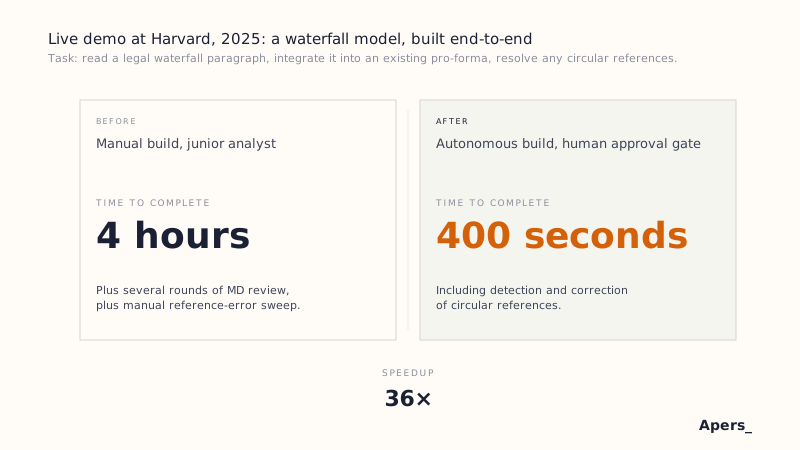
The video on the talk page is sped up; the real elapsed time was about 400 seconds. The system reads the legal paragraph using vision capability on a screenshot of the LPA, reasons about which cells need to change, asks for approval on each row of changes, executes them, detects the circular reference it accidentally created, and corrects itself. When I built models like this in my first year in private equity, the same task took four hours of focused work with several rounds of MD review. The 36× speedup is the headline number. The structural shift is the headline insight: the work has stopped being labor and started being supervision.
Two things to notice. First, the autonomy is approval-gated. The user clicks "approve" on each row of changes — or "approve all" for routine ones. This is autonomy in the Tesla-driving sense, not the "set it and forget it" sense. Someone is still holding the wheel. Second, the system makes mistakes. The circular reference was the system's error. The recovery — noticing the error and fixing it — was also the system's. A junior analyst would have made the same mistake. A junior analyst would not have caught it without escalation.
The shift in the analyst role is from making decisions to verifying them. From doing the work to managing the system doing the work. This is not a hypothetical change. It is what an analyst in a boutique fund in 2026 actually does, hour to hour.
Three Implications
If the underlying argument holds — compute substitutes for labor, capital flows to the more efficient layer, real estate becomes computable first — three things follow.
From firms to protocols.
What is a GP selling? Strip away the marketing and the LP-relations function, and the answer is a unique insight into the market, and the conviction to execute on it. That is the thing the LP cannot buy elsewhere. The 30 analysts, the global research teams, the 4,000-person headcount — those are operating cost. As autonomous tooling absorbs more of the analytical work, the operating-cost layer compresses toward zero. What's left is the insight and the conviction.
When the cost layer collapses, what was a "firm" starts to look more like a "protocol": a small group with a thesis, an execution layer that runs the analytical work, and a price to the LP that reflects the actual value being added rather than the operational overhead of being added. The shift is from organizational chart to insight per basis point.
Alpha from proprietary access.
In a world where the analytical layer is commoditized, alpha cannot come from doing the analytical work faster. Everyone has the same fast analytical layer. Alpha has to come from somewhere the analytical layer cannot reach.
Three sources remain. Proprietary access — markets where getting the deal flow requires being physically present, speaking the language, or having relationships that don't survive a Zoom call. Parameter tuning — the conversion of an informed market view into the specific numbers (rent growth, exit cap, lease-up speed) that determine whether a deal pencils. And structural creativity — distressed credit, opportunistic situations, bespoke capital structures where every deal is genuinely different and the playbook from the last deal does not apply.
The interesting consequence: the firms that win in 2026 are the ones that are bad at what autonomous tooling is good at, and good at what autonomous tooling is bad at. The complementarity is the strategy.
The surviving analyst.
Which brings us to labor. If the analytical layer is commoditized and the cost layer is compressing, what is the new graduate entering institutional capital actually betting on when they take the job?
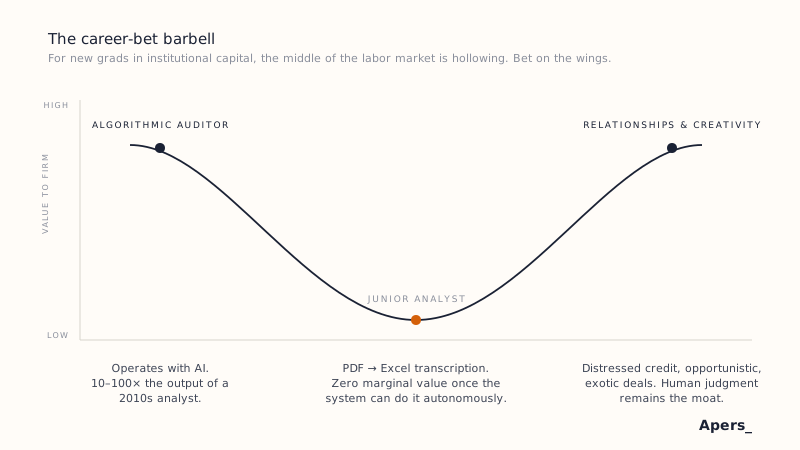
The middle is hollowing. Specifically: the junior analyst whose job is "transcribe the PDF, build the lease schedule, populate the waterfall" — the role I held in my first year — is the role with the most rapidly compressing economic value. The system can do it now, at 36× speedup and improving. The hours of work that used to constitute training the next generation of professionals are simply not there anymore.
What is left at the high end is two distinct profiles. On one wing: the algorithmic auditor — the analyst who operates with the system, knows its failure modes, and unlocks 10× to 100× the output of a 2010s-era analyst by managing the system rather than competing with it. On the other wing: the relationship-and-creativity specialist — the one who works on the distressed deals, the opportunistic situations, the exotic structures where the system cannot do the work because the situation is genuinely novel.
If I were graduating today, I would bet on one of those two wings. The middle is the bet I would not make.
The Open Question: Fiduciary Responsibility
I do not have a clean answer to this one, so I want to flag it rather than pretend.
The traditional accountability model for capital allocation is the investment committee. A group of senior people sit around a table, hear a deal presentation, ask questions, and vote. When the deal goes badly, the responsibility is collective — and the committee structure exists in part because shared responsibility is a better risk-management mechanism than concentrated individual responsibility. The structure also satisfies the legal and fiduciary frameworks that govern how LP capital can be deployed.
In an autonomous workflow, the structure is different. The system surfaces a deal. A human reviews the summary. The human approves or rejects. The deal executes. When it goes badly — and some will — who is responsible? The human who approved a system-generated recommendation they did not have time to fully audit? The team that built the system? The team that calibrated it to the firm's preferences? The LP who selected the GP knowing the GP used autonomous tooling?
There is no precedent for this. The closest analogues are quantitative public equity strategies, where the fund manager is responsible for the strategy and the inputs but not for individual trades — but private capital allocation has many more degrees of bespoke human judgment per decision than public equity does. The fiduciary frameworks that govern institutional capital were written before autonomous tooling existed, and they will need to be updated. I do not know what the right framework looks like. I am reasonably sure the next decade of LP-side governance is going to spend a lot of time figuring it out.
If you are at an institutional allocator and you have thoughts on this, I would like to hear them. francis@apers.app.
Three Takeaways
To close, three things to leave with.
ONE — INEVITABILITY
Capital flows to the more efficient layer. This is not a prediction. It is the same law that compressed active equity management to ETFs over forty years, and it is now compressing private capital management on a faster clock. Fighting it has not historically gone well for the firms doing the fighting.
TWO — STRUCTURE
"Make capital think" is not a slogan. It is the operational consequence of removing the organizational friction that sits between the LP's allocation decision and the actual deployment of capital. The winning firms in 2026 are the ones that adopt this from day one — not the ones that subscribed to Microsoft Copilot, called it a transformation, and praised themselves during the Q2 investor meeting.
THREE — CAREER BET
If you are graduating this year and trying to figure out where to go: the wings of the labor distribution, not the middle. Be the algorithmic auditor who unlocks the output of the firm. Or be the creative deal-maker who works on the situations the system cannot do. The thing not to be is the junior analyst whose comparative advantage is doing the work the system also does, only more slowly.
Compressed to one sentence: 2026 is the year the cost, the technology, and the engineering finally arrived at a point where autonomous financial institutions are not a thesis. They are the structure under which capital is going to be allocated for the next fifty years.
Tomorrow looks very different. I hope you are as excited about it as we are.