

XL-2 is Apers' modeling engine for institutional real estate. The most powerful one Apers has built yet. It constructs complete financial models from deal-level inputs and operates within existing models of any complexity — tracing dependencies, identifying logic, extending analysis without breaking established structure.
XL-2 is available to all Apers users today. [Click Here to Access]
A system built for the problem
Institutional real estate models are computational systems: 30, 40, sometimes 60 interconnected tabs. Lease-by-lease revenue builds. Multi-tranche capital stacks. Promote waterfalls with tiered return hurdles. Argus exports feeding into consolidation models feeding into IC packages.
We tested leading general-purpose AI systems — including GPT-5.3 and Claude Opus 4.6 — against models of this class. Context window limits were reached before the full model structure loaded. Outputs failed to reconcile. Waterfall logic broke without error. Named range conflicts went undetected.
These are not edge cases. They are properties of institutional-grade CRE models. XL-2 is built to handle them.
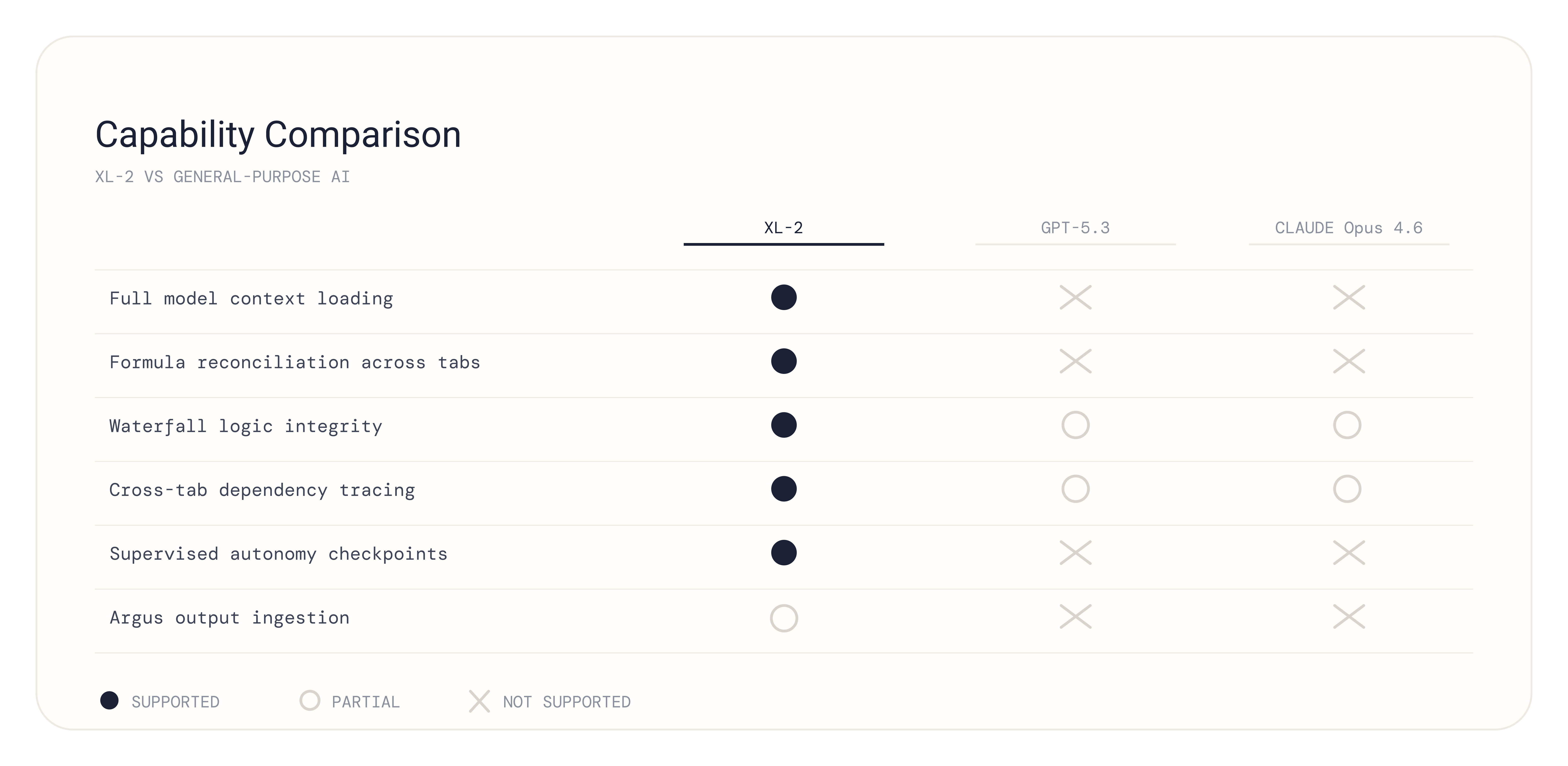
Capabilities
Model Construction
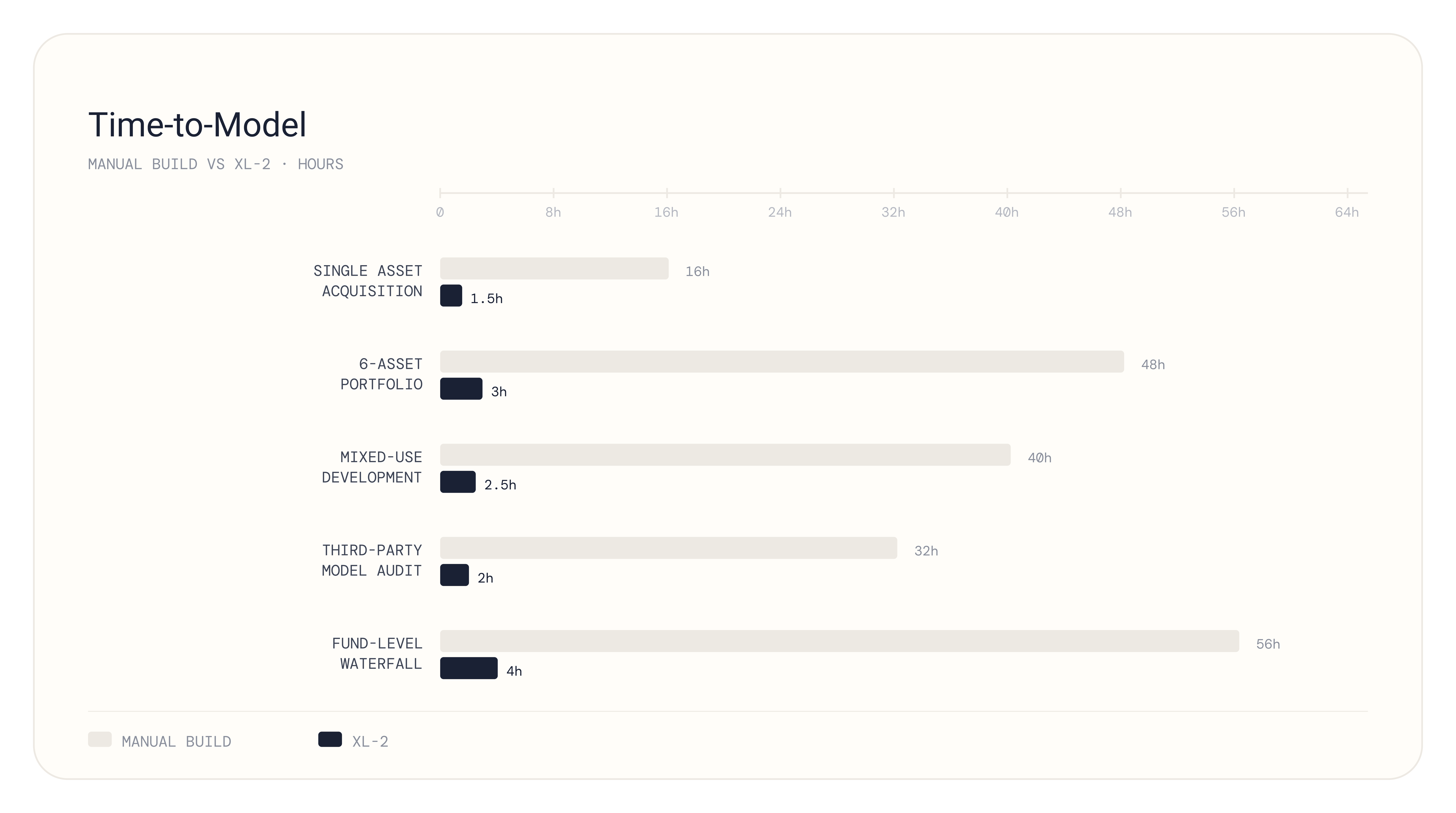
Given deal-level inputs — property data, lease information, capital structure parameters, return targets — XL-2 constructs a complete institutional-grade financial model. Cash flow projections, debt service schedules, partnership waterfall, return metrics, sensitivity analysis. The formulas reconcile.
XL-2 covers income-producing real assets across multifamily, office, industrial, mixed-use, hotel, and other institutional property types.
Supported components: lease-by-lease cash flow builds, promote structures, tiered return hurdles, multi-tranche capital stacks, Argus integration.
Model Comprehension
XL-2 reads existing models regardless of complexity or origin. It identifies assumption architecture, cash flow construction logic, waterfall structure, and how sensitivity tables reference core inputs. It then operates within that framework — updating inputs, running scenarios, extending analysis — without modifying the dependencies the existing structure relies on.
Supported operations: cross-tab dependency tracing, named range disambiguation, third-party model audit, shop-specific calibration.
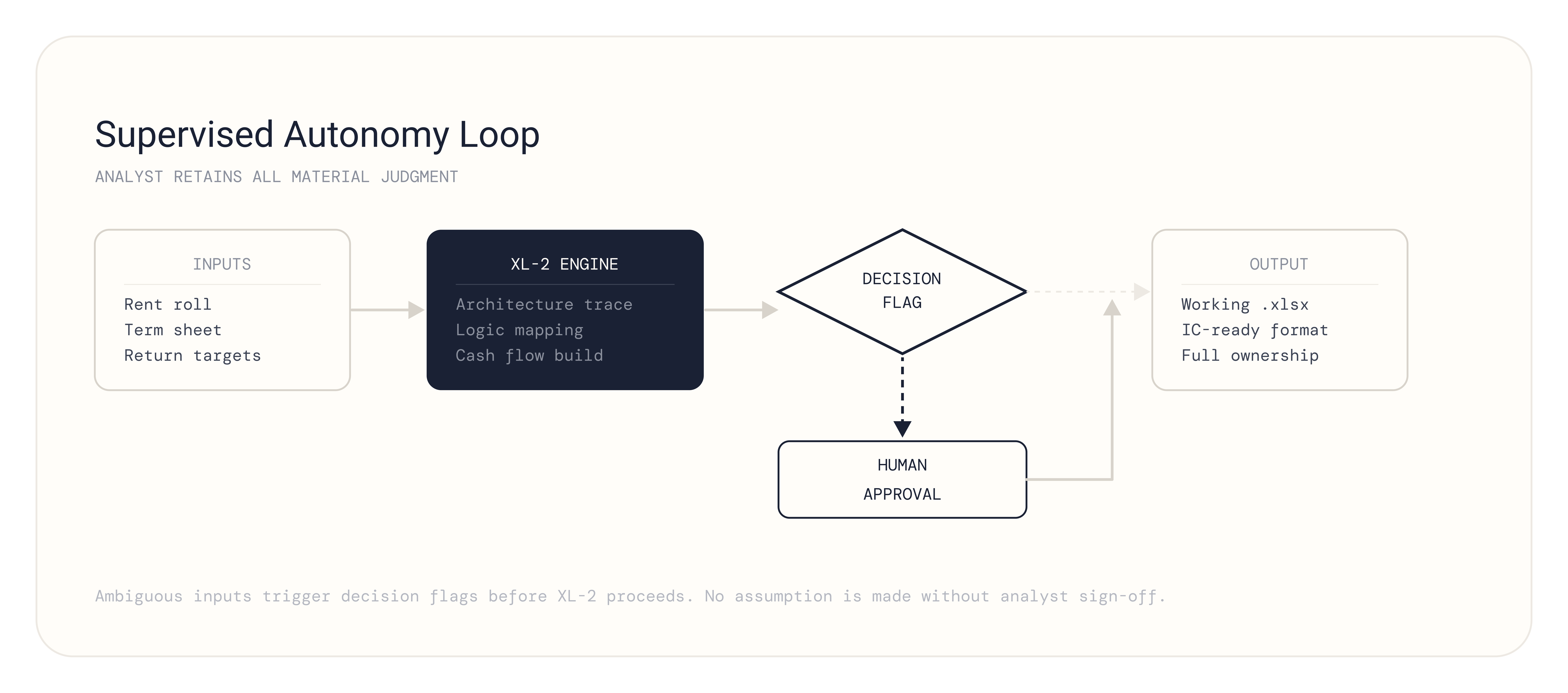
Supervised autonomy
At critical structural decision points — cash flow organization, assumption set selection, treatment of ambiguous lease terms, placement of debt tranches within the capital stack — XL-2 surfaces decisions for user approval before proceeding. Every material modeling judgment remains with the analyst.
Model ownership
Every model XL-2 produces is a standard .xlsx file. It opens in Excel and can be distributed to investment committees, lenders, joint venture partners, and limited partners without requiring Apers access. No proprietary format. No platform dependency.
Supported inputs: XLSX · XLS · XLSM · CSV · PDF · Scanned documents · Argus exports
Output: Standard .XLSX · IC-ready · No lock-in
Research
XL-2 is built on a framework we proposed for autonomous construction and comprehension of structured financial models, detailed in XL-2: Autonomous Construction and Comprehension of Structured Financial Models via Domain-Grounded Agentic Computation, available in the Research section of the Apers website.
XL-2 is available to all Apers users today. [Click Here to Access]
About Apers
Apers was founded by researchers from Harvard, Yale, and MIT with backgrounds in artificial intelligence, asset pricing, and institutional real estate investment. Our mission is to advance the science of capital deployment by applying autonomous agents and machine reasoning to real asset markets.


