RESEARCH
Identifying Priced Factor Exposures in Private Real Estate from Lease Contract Structure
Introduction
A factor pricing framework for private real estate that derives risk premia from the lease contract rather than from historical returns.
Today we are releasing a working paper, The Contract Is the Asset: A Factor Pricing Framework for Real Estate, available on SSRN. The paper argues a simple thing with strong consequences: the risk premium of a private real estate asset is determined by the terms of its lease, not by its property type. Two observable parameters of the contract — the share of the holding period exposed to market rents, and the share of operating costs passed through to the tenant — control the weights on three priced risk channels: credit, market rent, and operating cost. Vary those two parameters and you trace a continuous spectrum from a risk-free bond to a pure equity claim. Property type falls out of the pricing equation as a redundant label.
Why Return Regressions Break in Private Real Estate
Modern factor pricing — Fama-French, Carhart, Hou-Xue-Zhang — works by regressing observed returns on candidate factors and reading off the loadings. The procedure is sound when returns come from continuous, arm's-length transactions. In private real estate, they don't.
Properties trade infrequently and at substantial transaction cost. Short-selling is infeasible. Most "returns" reported by the industry are not realized prices at all — they are appraisals, smoothed by valuation conventions that average across recent comparable transactions. Geltner (1993) and the literature that followed documented this smoothing as a moving-average process that systematically attenuates measured covariances with contemporaneous factors. The bias is structural, not a matter of data quality. Factor loadings estimated from smoothed returns inherit the smoothing.
The preconditions Arbitrage Pricing Theory needs — large cross-section, unrestricted short-selling, continuous trading, enforcement of the law of one price through arbitrage — are violated. So factor pricing in private real estate can't be borrowed from equities. It has to be derived from first principles.
Read the Risk Off the Lease
Real estate payoffs have a structural feature equities don't: near-term cash flows are determined by a legal contract. The lease specifies a fixed rent for a known period, assigns operating cost responsibilities between landlord and tenant, and identifies a counterparty whose creditworthiness can be observed independently.
That contractual structure generates a natural accounting decomposition of the property's payoff into three pieces. Each piece carries a different kind of risk, and the lease itself tells you the weights.
- Contractual revenue — fixed rent owed by a named tenant for the remaining lease term. The risk is that the tenant defaults.
- Market revenue — rent earned after the current lease expires, set by supply and demand at that future date. The risk is that market rents are lower than expected.
- Operating costs — the running expenses of the building, partly or fully reimbursed by the tenant depending on the lease structure. The risk is that costs move with the cycle in a way the owner bears.
Two parameters control how much weight each piece carries:
PARAMETER DEFINITIONS
δ (delta) — market exposure. The share of the investor's holding period that fallsafter the current lease expires. δ = 0 means the lease covers the entire hold; δ = 1 means the building is effectively vacant.
α (alpha) — cost pass-through. The share of operating costs the tenant pays. α = 1 is a triple-net lease; α = 0 is a gross lease where the owner bears every cost.
Both parameters are observable. You can read them off the lease document without estimating anything from price data.
Three Priced Channels: Credit, Market, Cost
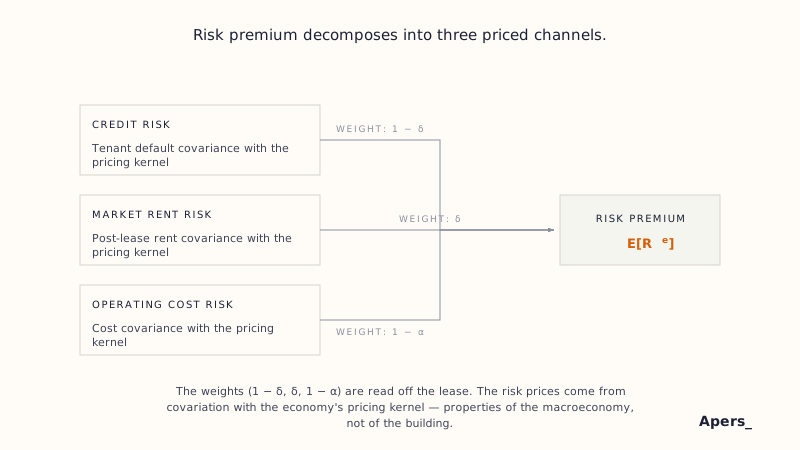
Apply the stochastic discount factor to this decomposition and the risk premium falls out as a weighted sum of three terms, each compensating for a different source of systematic risk:
- Credit risk (weight: 1 − δ). The covariance of tenant default with the pricing kernel — the same risk a bondholder bears. Defaults spike in recessions when marginal utility is high, so the covariance is positive and the risk price is positive.
- Market rent risk (weight: δ). The covariance of post-lease market rents with the pricing kernel — the same growth risk an equity holder bears. Rents fall in recessions, so the risk price is positive.
- Operating cost risk (weight: 1 − α). The covariance of operating costs with the pricing kernel. Sign depends on whether costs are procyclical (positive premium) or counter-cyclical (negative).
PROPOSITION 1 — IN ONE LINE
E[Rᵉ] = (1 − δ) · λcredit + δ · λmarket + (1 − α) · λcost
The risk premium is not a single quantity attached to the asset class "real estate." It is a weighted sum of three distinct risk compensations, where the weights are read off the lease and the prices are properties of the broader economy. Change the lease and you change the risk premium, even if the building doesn't move.
The Contractual Spectrum: Bond on One End, Equity on the Other
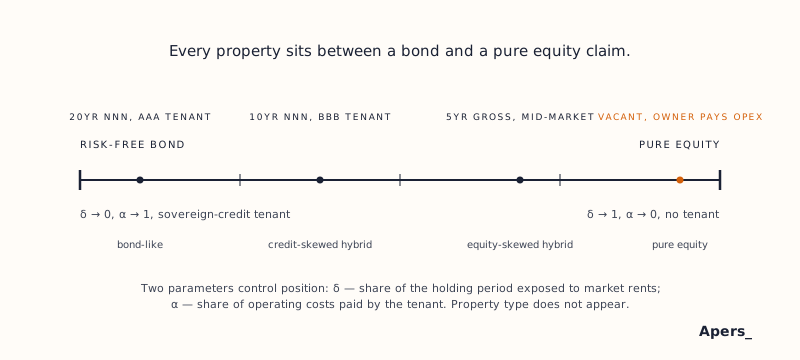
The decomposition has a striking implication. Take the two contract parameters to their corner values and the asset behaves like something familiar.
Set δ → 0 (long lease, no market exposure within the hold), α → 1 (triple-net, no cost burden), and pick a tenant with negligible default risk. The market and cost terms vanish; the credit term shrinks toward zero as default probability goes to zero. What remains is a stream of fixed payments owed by a creditworthy counterparty — the payoff structure of a long-dated bond. The pricing equation that governs corporate debt governs this property.
Set δ → 1 (no lease left, holding period entirely exposed to market rents), α → 0 (gross lease, owner pays all costs). The credit term vanishes. The risk premium becomes pure market plus pure cost exposure — a claim on net operating cash flow with no contractual protection. The pricing equation that governs equity governs this property.
For every value of (δ, α) in between, the asset is a blended claim. The bond-equity distinction in private real estate is not a metaphor or a marketing taxonomy. It is the corner cases of a single mathematical object that contains everything else.
Why Property Type Drops Out
The most consequential result follows from the first two. If two properties have the same (δ, α) and their tenant cash flows respond to the macroeconomy in the same way, they earn the same risk premium — regardless of whether one is classified as industrial and the other as office.
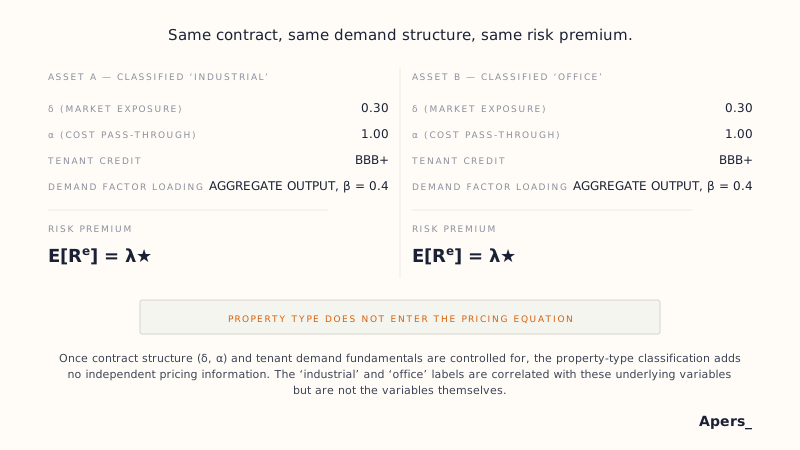
This isn't a claim that property type is empirically irrelevant. It is a claim about what property typerepresents. Property classifications are correlated with lease structure (industrial assets are typically longer-leased and more triple-net than office) and with tenant demand fundamentals (logistics tenants load differently on aggregate demand than coworking operators). When return regressions assign explanatory power to property type, they are picking up systematic variation in (δ, α) and in covariance structure — variables that the classification happens to proxy.
Once those underlying variables are measured directly, the classification has nothing left to add. Property type is a useful label for inventory management and for matching buyers to brokers. It is not a pricing factor.
What the Framework Predicts
The three propositions generate testable predictions. The paper states them qualitatively; companion papers develop the formal test designs.
| Prediction | What it claims | How you'd reject it |
|---|---|---|
| 1 | Cross-sectional variation in cap rates is better explained by (δ, α, credit quality) than by property type dummies. | A regression of cap rates on contract parameters should have higher R² than a regression on property type dummies, with property type adding little incremental explanatory power. |
| 2 | Properties at opposite ends of the (δ, α) space behave like different asset classes. Low-δ, high-α assets should co-move with credit spreads. High-δ, low-α assets should co-move with growth. | If both ends of the spectrum showed the same factor sensitivities, the spectrum interpretation would fail. |
| 3 | After controlling for contract parameters and tenant demand structure, property type indicator variables should lose statistical significance in pricing regressions. | If residual property type effects remain large after that conditioning, something other than contract structure is doing the pricing work. |
Each prediction is a place where the framework could be wrong. That is the point of stating them.
Limits and What Comes Next
The paper develops the decomposition in a two-period economy with stabilized properties and observable lease contracts. That setting is deliberately spare. It abstracts from lease escalation clauses, CPI adjustments, percentage rent provisions, free rent concessions, and options to renew or terminate. Each of those features can be layered in as a modification to the contractual rent schedule or to δ, but each adds notational complexity without altering the decomposition structure.
The two-period framework also doesn't speak to the term structure of risk premia — how the same property is priced across different holding periods — which is a richer question we treat in subsequent work. And the framework assumes the lease parameters and tenant cash flow distributions are observable; in practice, both require data work to construct at scale.
Three companion papers extend the framework:
- A pricing theory for capitalization rates that translates the abstract risk premium decomposition into the observable metric practitioners actually quote.
- A forward-looking methodology for computing property-level factor exposures from contract data and external market information, without reliance on appraisal-based return series.
- An empirical test of the property-type redundancy result using cross-sectional transaction data.
Each one operationalizes a different part of the theory. The first turns the framework into language deal teams already speak. The second produces factor loadings you can compute today, from documents you already have. The third asks whether the data agree with the model.
What we are doing in this paper, and what the framework is for, is establishing that risk in private real estate has a structure — and that the structure is legible from the contract. Once you can read it, you can price it.