Why Adaptive Reuse Is Its Own Discipline
Adaptive reuse and redevelopment underwriting sits between ground-up development and stabilized acquisition, and neither of those pro formas prices it correctly. A team that reaches for a ground-up development pro forma when the deal is a 1960s office building being converted to eighty apartments will misprice the project on almost every input that matters. Cost is not a per-square-foot vertical build number; it is a demolition budget plus a selective preservation budget plus a new-use fit-out. The schedule is not zoning-to-CO; it is entitle-a-change-of-use before the first tradesperson arrives. The exit is not a stabilized hold with a residual cap; it is a sale event at completion, and the underwriting question the model has to answer is what the finished product sells for, not what the ten-year IRR looks like.
Reaching the other direction is just as wrong. A team that reaches for a stabilized acquisition pro forma because the building already exists will miss the eighteen months of monthly construction draws, the capitalized interest that never touches cash flow, and the fact that there is no NOI until stabilization. Adaptive reuse sits between the two disciplines and shares mechanics with both, which is exactly why it needs its own model.
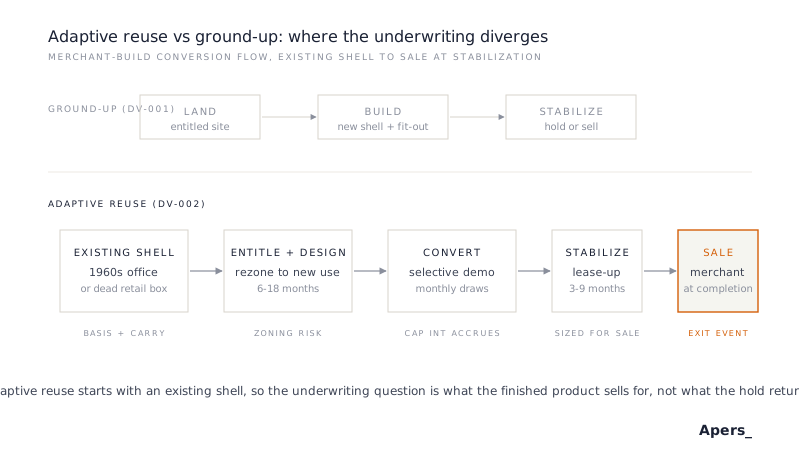
This article walks through the framework a proper adaptive reuse underwrite implements, then shows how DV-002, the Apers open institutional-tier model, runs that framework on the sheet.
The Existing Shell Is a Cost Saver and a Cost Driver
The instinct that adaptive reuse is cheaper than ground-up is half right. Preserving the structural frame, the elevator cores, and often the facade avoids the largest single line item on a vertical build. In a friendly conversion (office floor plate that suits residential unit depths, a shell that already meets modern seismic and envelope codes), that saving is real and meaningful.
The instinct is wrong when the shell fights the new use. A center-core office floor plate wants double-loaded corridors that most residential unit mixes cannot deliver without expensive workarounds. A single-story big-box retail shell wants vertical multifamily circulation that did not exist in the original design. Older mechanical, electrical, and plumbing systems almost always come out, and the demolition cost of removing an existing system is a line item that ground-up never sees. A model that treats the existing shell as pure savings will systematically underprice the conversion budget.
The framework asks for hard costs in three separate buckets: preservation (structure, envelope, and systems that stay), selective demolition (what is removed to make room for the new use), and new-use build-out (interior construction to deliver the finished product). Any one bucket alone is a partial picture. All three together are what the general contractor is actually pricing.
Zoning and Entitlement Are Priced Risk, Not a Line Item
Every adaptive reuse project is a change-of-use application. Office to residential requires residential zoning, residential parking standards, residential building code compliance, and often a new certificate of occupancy that classifies the building as multifamily. Retail to multifamily is the same story with a different starting classification. The entitlement path takes six to eighteen months in most jurisdictions, sometimes longer, and the outcome is not guaranteed on day one.
The framework treats entitlement two ways. First, as a schedule cost: the carry (property taxes, insurance, minimal debt service on the acquisition loan) during the entitlement window is a real line item that ground-up development frequently gets to skip because it acquires already-entitled land. Second, as a scenario input: the reviewer should be able to model the deal at the assumed entitlement timeline and at a delayed one, because the difference between twelve months and twenty-four months of pre-construction carry can move project IRR by hundreds of basis points on smaller deals.
A proper model does not price a zoning approval as certain. It asks the reviewer to state the assumption, then it stresses the timeline in the sensitivity view.
Monthly Draws and the Capitalized Interest Reserve
Construction cash outflows are not evenly distributed. The typical adaptive reuse project draws lightly in the first quarter of construction (mobilization, selective demolition, permits), accelerates through the middle two quarters (structural retrofit, MEP replacement, framing, drywall), and tapers in the final quarter (finishes, punch list, commissioning). The construction loan advances in monthly tranches against those draws.
Interest on the outstanding balance accrues from day one of the first draw. Because the property is not generating income during construction, that interest cannot be paid out of operations. It is capitalized: added to the outstanding loan balance rather than paid in cash. The construction lender sizes an interest reserve on day one to fund this capitalization for the duration of the build. A model that does not size the reserve properly under-reports total project cost, and a model that treats interest as a monthly cash expense mis-states construction-period cash flow.
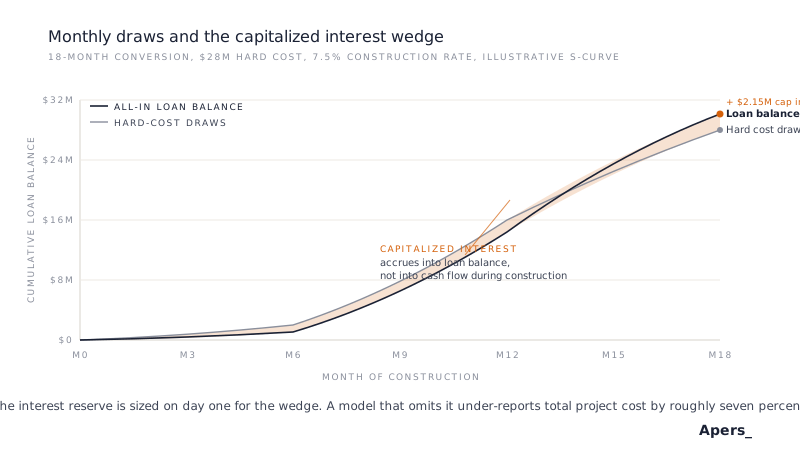
The framework asks the reviewer to enter draws as a monthly percentage of the total budget or, more commonly, to pick a standard curve archetype (front-loaded, back-loaded, or symmetric S-curve) and let the model distribute the monthly amounts. Either way, the interest accrues on the running balance, the reserve is sized from that accrual, and the reserve appears in the sources-and-uses table as a real use of capital.
The Merchant Sale Is an Exit Event, Not a Hold Assumption
A stabilized acquisition pro forma frames the exit as a hold assumption: at year five or year ten, apply an exit cap to the projected NOI, subtract selling costs, and compute residual value. The exit is a modeling convention. The deal really is held.
A merchant-build adaptive reuse project inverts the framing. The exit is the point of the deal. The sponsor is building to sell, and the underwriting question is what price the finished product commands in the market at the moment of stabilization. That price is not a residual off a hold; it is a comparable sale against recently transacted product of the same use and vintage in the same submarket. If the comparable set does not support the exit price, the deal does not work regardless of how sharp the construction budget is.
Practically, the framework replaces the hold-then-exit-cap sequence with two inputs: an exit price per unit (or per square foot) drawn from comps, and a marketing-and-sale timeline drawn from local absorption. Residual is a comp-driven number, not a cap-rate arithmetic. The exit cap still appears in the model, but as a check on comp reasonableness, not as the primary residual driver.
The related decision is whether the sponsor might hold instead of sell. A serious model surfaces both outcomes side by side: merchant-sale proceeds at stabilization versus stabilized-hold projected returns. The choice between them is a capital-partner conversation, and giving the LP both numbers is more honest than picking one.
How DV-002 Runs the Framework
DV-002 is the Apers open institutional-tier model that implements this framework. The existing-shell section captures acquisition basis plus the three hard-cost buckets: preservation, selective demolition, and new-use build-out. The entitlement section captures pre-construction carry with the timeline as a stressable input. The construction section runs an eighteen-to-thirty-six-month schedule with monthly draws distributed by a curve archetype, calculates capitalized interest on the running balance, and sizes the interest reserve into the sources-and-uses. The exit section takes a comp-driven sale price with a marketing timeline, returns a stabilized-hold alternative alongside, and reports merchant returns and stabilized returns as parallel outputs.
The model deliberately excludes several things a larger development platform would include. There is no multi-phase reuse logic: the framework assumes a single-phase conversion, and a multi-building or multi-phase master plan is a different modeling problem. There is no historic tax credit or new markets tax credit equity module: those credits change both the capital stack and the exit-buyer pool, and embedding them in the base model would push it toward a specialized federal-credits tool. There is no tenant-improvement modeling on the delivered product: for a for-sale merchant build the buyer prices TI; for a stabilized hold the reviewer moves to the asset-class-specific pro forma. Each omission traded scope for solvability at the redevelopment tier.
When DV-002 Stops Being Enough
DV-002 is purpose-built for a single-phase conversion of an existing structure. It stops being the right sheet when the deal changes shape. Pick the model that matches the actual scope:
- Ground-up new construction on an entitled site: DV-001 Ground-Up Development
- Bridge-to-permanent debt transition after stabilization: DV-003 Construction-to-Perm Loan Transition
- Ongoing draw and cost tracking during the build: DV-004 Construction Project Cost Tracker
- Heavy-lift multifamily repositioning that stays in-place: AQ-141 Multifamily Opportunistic Pro Forma
- LIHTC-eligible affordable conversion: TX-101 LIHTC Screening Model
The handoff preserves the core structure of the DV-002 workspace. Existing basis, hard-cost buckets, monthly draw schedule, and interest reserve transfer directly to DV-001 for a ground-up variant or to DV-003 when the sponsor chooses to hold and refinance rather than sell. The exit inputs change form depending on the destination, but the construction spine is the same.
Related Models
DV-001 Ground-Up Development is the adjacent development strategy: entitled land instead of an existing shell, new construction instead of conversion, and typically a stabilized hold at the end rather than a merchant sale. The two models share the monthly draw and capitalized interest mechanics but diverge on almost everything else. Teams that underwrite both strategies use them side by side.
DV-003 Construction-to-Perm Loan Transitionis the debt-mechanics companion. Where DV-002 assumes a merchant sale at stabilization retires the construction loan through sale proceeds, DV-003 sizes the permanent loan against stabilized NOI and models the recapture of any equity gap. When a sponsor toggles from merchant to hold, DV-003 is the next sheet on the desk.
DV-004 Construction Project Cost Tracker is the post-close operations tool. DV-002 underwrites the project on day zero; DV-004 tracks actual draws, change orders, and contingency burn during the build so the sponsor can compare live progress to the underwritten plan. The two live on either side of the closing date.