When Office Is Core
Underwriting a stabilized core office acquisition starts with a filter test, because most office buildings do not qualify. Most institutional office rosters have a concentration problem, a rollover cliff, or a base-year reset that dominates the underwrite. A deal is core office when the rent roll has already resolved those questions: weighted average lease term above eight years, at least half the leased SF signed by investment-grade tenants, contractual escalations written into the leases, and no single rollover event large enough to move IRR by more than 100 basis points if it goes the wrong way.
On a deal that qualifies, the underwriting problem inverts. The value-add office model asks what happens if the anchor leaves. The core office model asks what happens if nothing does. The cash flow is contractual, the recoveries are predictable, and the pricing question is about the exit cap and the debt cost, not about lease-up velocity or leasing capital.
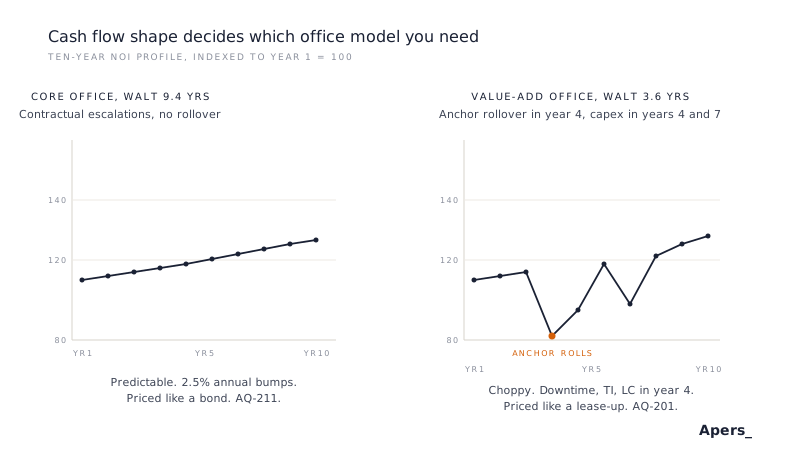
This article walks through the framework a core office model has to implement, then shows how AQ-211, the Apers open core office pro forma, operationalizes it on a stabilized ten-year hold.
WALT Is the Metric That Defines the Deal
Weighted average lease term is the single number that separates a core office underwrite from any other office underwrite. WALT is the sum of each tenant's remaining lease term multiplied by that tenant's share of leased square footage. It answers one question: how long is the contractual cash flow guaranteed before the market gets a vote?
The core threshold is roughly eight years. Below that, rollover exposure inside a standard ten-year hold is the story regardless of tenant quality, because too many leases turn during the hold period and the cash flow the buyer is paying for is not the cash flow the buyer receives. Above ten years, the deal is priced almost entirely off contractual income and residual value, and the market rent question moves to the exit rather than the hold. Between eight and ten is the working range where the core discipline applies but the reviewer has to watch which tenants sit in the tail.
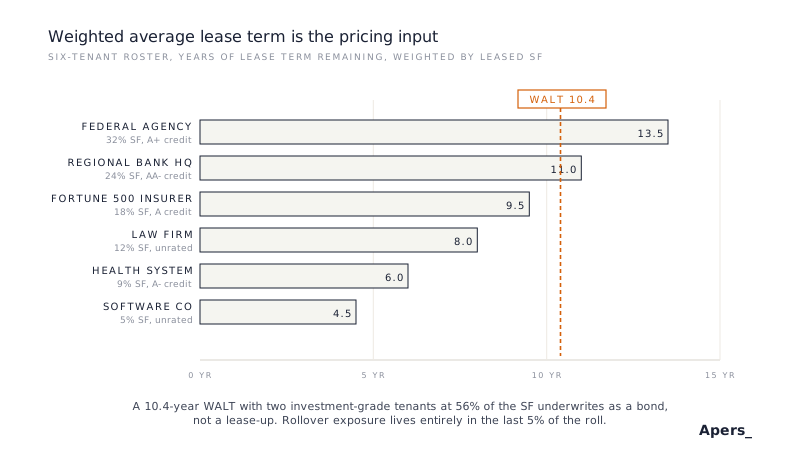
A useful WALT reads two ways. Weighted by SF is the standard, and it is the number most institutional reports quote. Weighted by rent (or by NOI) is the honest one, because a small tenant paying a large rent premium can carry disproportionate influence on the cash flow. Reviewers should compute both and note any material divergence, because divergence flags a tenant whose above-market rent is doing more work than their SF footprint suggests.
Tenant Credit and Concentration Are the Downside Case
A long WALT protects the cash flow only as far as the tenants honor the lease. Core underwriting reads the roster as a credit portfolio and asks the same questions a fixed-income desk would ask about a bond ladder. What share of the rent is investment-grade. What share is unrated but publicly filing. What share is private credit that has to be diligenced individually. And what happens to the WALT if the largest unrated tenant defaults in year three.
Concentration is the tail-risk metric. A single tenant at more than 25% of leased SF is a concentration exposure regardless of credit, because ratings migrate and even investment-grade tenants can be downgraded during a ten-year hold. The core underwrite runs the returns block with the top tenant flagged as vacate-in-final-year and compares the answer to the base case. If the delta is inside 75 basis points of IRR, the concentration is inside the core envelope. If it is wider, the deal has value-add exposure hiding inside a core wrapper and belongs in a different model.
TI, LC, and Renewal Reserves Priced Into the Model
Even core office has capital events. Every lease in the roster will renew at least once during a twenty-year holding period, and roughly a third of them will renew inside a ten-year hold. Renewal packages carry TI, LC, and free rent, and while the numbers are smaller than new-lease packages, they still hit the cash flow at the specific month they occur.
The core model prices renewal TI at ten to thirty dollars per SF depending on submarket and tenant profile, LC at half the new-lease rate (typically two to three percent), and free rent at zero to three months on renewal. The critical discipline is that these reserves are computed against the specific lease expiration schedule, not amortized as a flat per-SF-per-year reserve. Reserving thirty cents per SF annually against a roster where 40% of the SF renews in year seven understates the year-seven capital call and overstates the year-three cash flow. The reserve line has to land where the events do.
Exit Priced at Cap Expansion, Not Compression
Core deals are almost always underwritten with an exit cap wider than the going-in cap. The reasoning is conservative but structural: the WALT that supported today's cap has decayed by the length of the hold, a buyer at exit is inheriting the shorter WALT, and shorter WALT trades at higher caps. A ten-year hold on a deal bought at a 6.0% cap with an 11-year WALT typically underwrites to exit at 6.25% or 6.50% with a remaining WALT closer to five.
The exit cap and the hold length interact. A three-year hold on the same building might justify a flat exit cap because the WALT has barely decayed. A ten-year hold on the same building rarely does. The core model should let the reviewer set the exit cap explicitly and stress it with a plus-25, plus-50, and plus-75 basis-point band. If the deal only clears the target IRR at a flat exit cap, the pricing rests on an assumption the reviewer should be uncomfortable with, and the sensitivity output should say so.
How AQ-211 Runs the Framework
AQ-211 is the Apers open core office pro forma. A tenant roster input area supports up to twenty leases, each with square footage, in-place rent, contractual escalation schedule, lease expiration date, credit rating, and renewal probability. A ten-year annual cash flow computes contractual rent with embedded escalations, expense recoveries against a per-lease base year, TI and LC reserves keyed to the specific expiration schedule, mark-to-market adjustments at the end of the hold, and reversion at an explicit exit cap. A returns block reports levered IRR, equity multiple, cash-on-cash by year, and annual DSCR against the input debt terms. A sensitivity block flexes the exit cap, market rent at rollover, and renewal TI/LC intensity.
The model deliberately holds several scope lines. There is no monthly cash flow grid, because on a core deal with long WALT the annual view is what the committee reads and the monthly view adds precision that is not doing work. There is no probability-weighted retention engine, because the deal thesis does not depend on speculative re-leasing, and the leases inside the hold are either renewing on already-negotiated terms or rolling to market on a schedule the reviewer sets explicitly. When rollover becomes the story, AQ-201 Office Full-Service Lease Rollover is the right model because it is built around probability-weighted retention and a 120-month monthly grid.
AQ-211 also omits a distribution waterfall and a debt-sizing engine. The waterfall lives inCS-001 Multi-Class Equity Waterfall and pairs with any pro forma. Debt is priced against fixed input terms rather than solved for a target proceeds figure, because at the core underwrite stage the debt package is either quoted or planned against a conservative LTV and a specific DSCR floor, and the model prices against those constraints rather than iterating against them.
Each of those omissions traded scope for solvability at the six-month build target. Adding a monthly grid to a core deal generates noise where predictability was the reason for the underwrite. Adding a probability engine would confuse the two office models and blur the choice between them. AQ-211 is the core cash flow engine, and it does that one job on a schedule that reads as clean as the deal.
When Core Stops Being the Story
Two conditions push a deal past what AQ-211 can express cleanly. First, if the WALT falls below eight years or a rollover event inside the hold materially moves IRR, the deal is no longer core and the lease-by-lease treatment matters more than the contractual escalation treatment. Second, if the strategy includes a repositioning, tenant relocation, or capital plan that displaces existing tenants during the hold, the cash flow now has a construction phase that the stabilized model was not built to carry.
- Multi-tenant office with real rollover exposure: AQ-201 Office Full-Service Lease Rollover
- Office triage across a pipeline of deals: AQ-200 Office Lease Rollover Pocket
- Repositioning or heavy-lift office: DV-002 Redevelopment / Adaptive Reuse
- Distribution waterfall on top of any pro forma: CS-001 Multi-Class Equity Waterfall
The handoff preserves the tenant roster, the debt terms, the escalation schedule, and the exit cap discipline. The next model expands the layer AQ-211 held constant (monthly cash flow, probability retention, capital plan phasing, or waterfall promote) rather than restating the lease-level economics.
Related Models
AQ-201 Office Full-Service Lease Rollover is the adjacent-strategy sibling for the same asset class. Same institutional tier, but built for the deal where rollover is the underwrite and probability-weighted retention on a 120-month monthly grid earns its keep. The two models draw the line between core and value-add for office at roughly the eight-year WALT threshold.
AQ-200 Office Lease Rollover Pocket is the upstream triage tool. A blended-annual rollover abstraction that ranks office teasers before either AQ-211 or AQ-201 gets the survivors. Use it to move fast through a pipeline of ten office deals and hand the two core candidates to AQ-211 for full underwriting.
AQ-111 Multifamily Core Pro Forma is the same-strategy sibling in a different asset class. It runs the same core discipline (contractual cash flow, exit at cap expansion, no probability retention) applied to a stabilized multifamily rent roll, where the unit-level turnover replaces the lease-level rollover as the source of noise the core underwrite deliberately holds constant.