The Stabilized Multifamily Diligence Problem
A stabilized multifamily acquisition that survived the pocket screen still has to survive investment committee, and the tool that survives with it is a full multifamily core pro forma. The pocket returned a priced verdict on eight inputs. IC will want ten more. Unit-mix rent roll. Line-item operating expenses benchmarked against the T-12. Property tax reassessment on the sale. Insurance step-up. A refinance in year five with real proceeds math. Unlevered return alongside the levered one.
None of that is exotic. The failure mode is not that shops skip the work. The failure mode is that they do the work inside a template built for value-add or opportunistic deals, then spend two days explaining why half the cells are set to zero. A stabilized asset does not have a renovation schedule, a promote structure, or a lease-up curve. The right model leaves those tabs out and spends the complexity budget on the things a stabilized deal actually turns on.
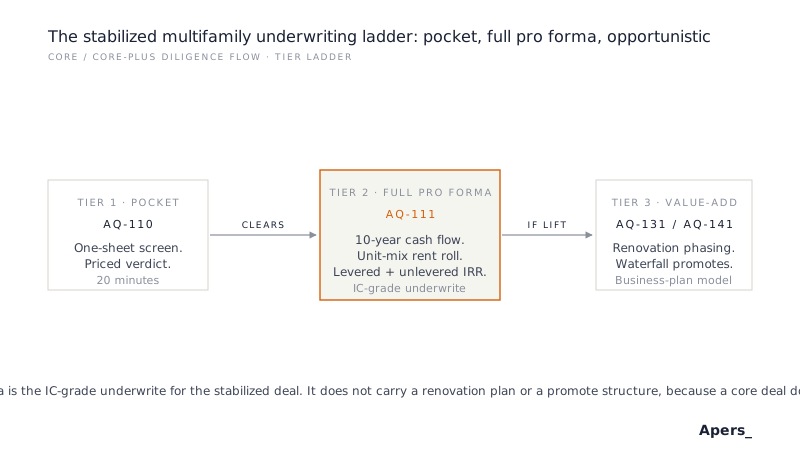
The framework this article walks through is the one a stabilized-core pro forma actually needs. It then shows how AQ-111, the Apers open multifamily core pro forma, implements that framework.
Why Ten Years, Not Five
Every underwriting decision starts with the hold horizon. Five years is the default for value-add and opportunistic deals because the whole point of those strategies is to execute a plan, harvest the lift, and exit before the market shifts. Core is the opposite. A core LP buys a stabilized asset because it wants durable cash yield over a long hold. Cutting that hold to five years to match a value-add template misprices the deal in two specific ways.
First, it forces the exit into the model's terminal-value assumption at exactly the moment the yield curve has done the least work. Five years is not long enough for the cap rate reversion assumption to be dominated by NOI growth. The number the model prints becomes a bet on where cap rates trade in year five, not a projection of what the asset produces. Ten years pushes the exit far enough out that the compounding NOI does more work than the exit-cap assumption.
Second, five years hides the refinance. Core deals almost always refinance mid-hold, whether to pull cash out on stabilized NOI growth, to lock in a lower coupon, or simply to extend the amortization schedule into the exit window. A five-year model treats the initial capital stack as permanent and misses the levered return the LP actually earns. Ten years brings the refi inside the frame.
Unit-Mix Rent Roll, Not a Blended Scalar
The pocket screen used a blended average rent because at the twenty-minute stage the blended number was both sufficient and honest. At the diligence stage that stops being true. A stabilized asset with a mix of studios, one-bedrooms, and two-bedrooms produces different rent trajectories by unit type. Studios lag one-bedrooms on rent growth in most metros. Two-bedrooms behave differently again, tied to household formation rather than to job growth. Rolling the three into a single scalar loses the signal the T-12 can actually deliver.
A proper stabilized pro forma carries the rent roll at the unit-type level. Number of units at each type, current in-place rent, market rent, loss-to-lease, and a per-type growth assumption tied to the submarket comp set. It is not more work than the pocket. It is different work, because the reviewer now has the signal to do it. If the diligence data room does not include a unit-type-level rent roll on a stabilized asset, the seller is either disorganized or hiding something, and either finding matters.
Line-Item OpEx, Not a Ratio
The pocket used an operating-expense ratio as a single scalar input. That is the right choice at the triage stage because the T-12 gives the reviewer one number and asking for more before the deal has cleared basic pricing is wasted effort. The full pro forma inverts that logic. Every expense line moves differently across a ten-year hold, and treating them as a fixed ratio to income embeds a false correlation that quietly kills the accuracy of the projection.
Property tax is the load-bearing example. Most jurisdictions reassess on the sale, which means the tax line in year one is a function of the purchase price, not the seller's historical basis. A pro forma that carries the seller's T-12 tax number forward is under-forecasting expenses from day one. Insurance is the second: post-2022 insurance markets have moved insurance from a predictable single-digit percent of EGI to a line that can double on renewal without warning. A ratio input averages over that risk. A line item exposes it. The remaining lines (payroll, utilities, R&M, management fee) each carry their own growth assumption so the reviewer can defend the underwrite to IC line by line rather than behind a single 32% ratio.
Paired Unlevered and Levered Returns
A core pro forma returns two IRRs, not one. The unlevered IRR answers the question of whether the deal works before leverage. The levered IRR answers what the LP actually earns after debt. The gap between them is the levered-return premium, and its shape carries real information about the deal.
A healthy core deal shows a modest unlevered IRR in the mid-single digits and a levered IRR in the high-single to low-double digits, with the gap reflecting a debt cost that clears the going-in cap. That is positive leverage, and the asset earns more than the debt costs. If only the levered number clears the target, the deal is working on debt arbitrage rather than on asset performance, and any move in rates reprices the entire return. If the unlevered IRR clears the target but the levered gap is thin, the debt terms are wrong for the deal.
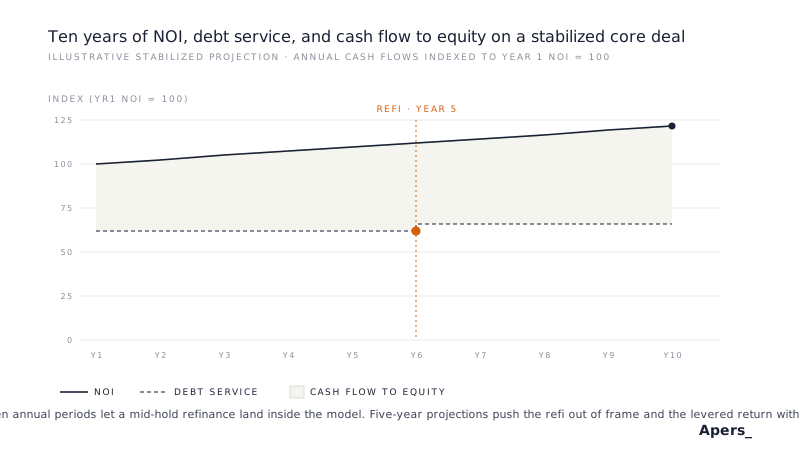
Both numbers have to be visible on the reviewer's sheet. Reporting only the levered IRR flatters deals that would fail on their own. Reporting only the unlevered IRR misses the equity return the LP is actually offered. The pair is what tells the whole story.
How AQ-111 Runs the Framework
AQ-111 is the Apers open model that implements this framework. Ten-year hold horizon, unit-mix rent roll on the assumptions tab, line-item operating expense schedule with per-line growth rates, a mid-hold refinance driven by target LTV against stabilized NOI, and a return panel that pairs unlevered and levered IRR with the equity multiple and the year-one cash-on-cash.
The model resolves cash flow monthly under the hood, then rolls to annual for the presentation layer. Monthly resolution is what lets debt service, refinance proceeds, and reserve draws reconcile properly. Presenting annually is what lets the IC memo read cleanly. The two are separate concerns.
The model deliberately excludes several things a value-add or opportunistic pro forma would carry. No renovation phasing schedule, because a stabilized deal does not have one. No per-unit-turn rent uplift track, because a core deal captures market rent at natural cadence rather than through a repositioning campaign. No distribution waterfall with promote tiers, because a core sponsor typically takes a flat asset management fee against a pari-passu equity structure. Each omission is the correct call for a core deal, and adding any of them would make AQ-111 a slower and less honest tool for the stabilized underwrite.
When the Core Pro Forma Stops Being Enough
AQ-111 is the right model when the plan is buy, hold, refinance once, and sell a stabilized asset. It is the wrong model when the plan has any of the following elements, and the reviewer should move to the matching pro forma instead:
- Renovation program with a loss-to-lease uplift story: AQ-131 Multifamily Value-Add Pro Forma
- Heavy repositioning, bridge-to-perm capital stack, or GP-LP promote structure: AQ-141 Multifamily Opportunistic Pro Forma
- Small-balance stabilized deals under fifty units: AQ-112 Small Multifamily Pro Forma
- Affordable or workforce housing with income restrictions: AQ-132 Multifamily Value-Add Affordable/Workforce
- Ground-up development rather than acquisition: DV-001 Ground-Up Development
The handoff preserves AQ-111's inputs. Purchase price, unit count, unit-mix rent roll, operating expense schedule, and debt terms all transfer directly. The value-add and opportunistic pro formas expand what AQ-111 held flat, primarily the rent trajectory (per-turn uplifts) and the capital stack (waterfall tiers), rather than restating the assumptions already in place.
Related Models
AQ-110 Multifamily Core/Core-Plus Pocket is the direct upstream sibling. AQ-110 returns a priced verdict in twenty minutes on the pricing question alone. AQ-111 is where the deal goes next once the pocket clears. The two models share the same input vocabulary so the handoff is a copy across, not a rekey, and the analyst does not lose the reasoning that got the deal to diligence in the first place.
AQ-131 Multifamily Value-Add Pro Forma is the adjacent-strategy sibling for the same asset class. When the diligence walk uncovers a renovation program that the pocket did not surface, the reviewer moves to AQ-131 rather than force the value-add plan into a core template. The two models share a reporting layout so the switch is visually continuous.
AQ-112 Small Multifamily Pro Forma is the same-tier sibling scaled for deals under fifty units. Shorter hold, simpler capital stack. Use AQ-111 when the deal is institutional and AQ-112 when it is not.