The Small Multifamily Gap
A small multifamily acquisition in the 5 to 50-unit segment is where most institutional pro formas are wrong for the deal. A twenty-two-unit garden walk-up, a forty-unit stabilized building over a corner grocery. These are the properties boutique shops, family offices, and first-time sponsors actually buy. They are also the properties that a template built for a 300-unit Class A asset overstates precision on and understates the mechanics that actually move the return.
The mismatch runs both directions. A pocket screener flattens the unit mix into a blended rent number, which loses fidelity fast when three of twenty units are mark-to-market legacy tenants. An institutional pro forma models a lease-up curve, a multi-tranche capital stack, and a distribution waterfall, none of which apply when the building is already leased, the debt is one loan from one bank, and the equity is the sponsor and three friends. The small-multifamily model has to be its own thing.
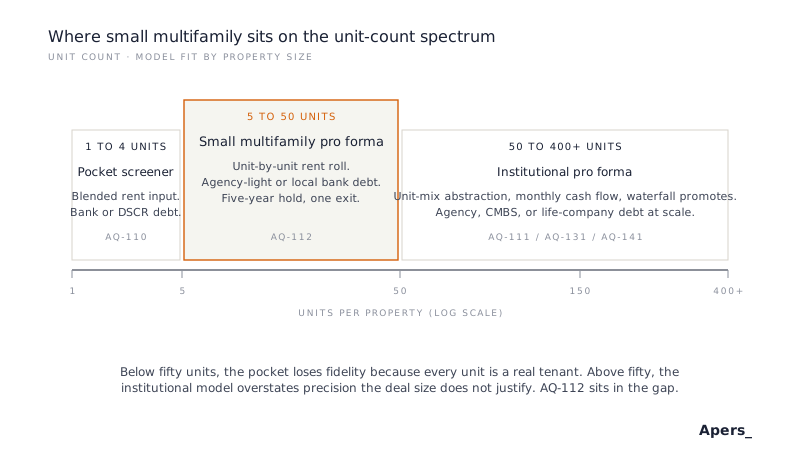
The framework this article walks through is the framework a proper small-multifamily model implements. It then shows how AQ-112, the Apers open small multifamily pro forma, operationalizes that framework on a single spreadsheet page.
Every Unit Is a Real Tenant
On an institutional multifamily deal, the rent roll is a statistical object. Two hundred units, six floor plans, an average in-place rent, a loss-to-lease percentage, a turnover assumption. The individual tenant does not move the return by any measurable amount.
On a fifteen-unit deal, the individual tenant is the underwrite. One long-tenure resident four hundred dollars below market is nine percent of gross income. The vacant unit on the second floor is a specific unit with a specific rent target and a specific delivery date. The month-to-month tenant in Unit 9 is a business-plan event, not a statistical drag. The rent roll is a list, not a distribution.
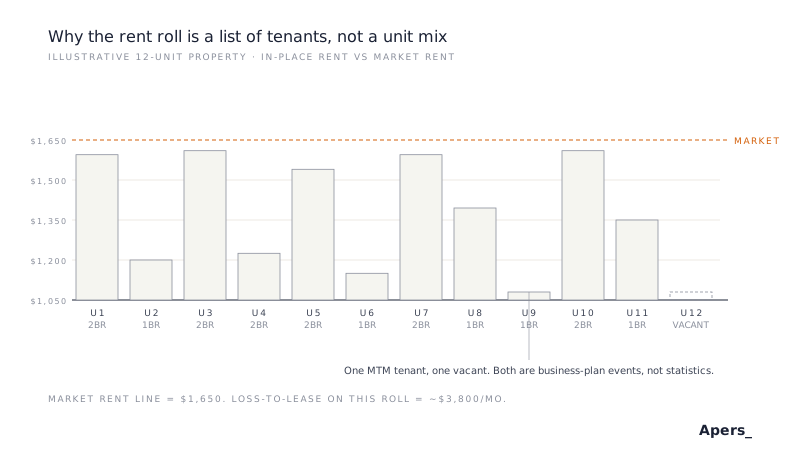
A pro forma sized for this segment has to accept a unit-by-unit rent roll as an input. In-place rent, market rent for that unit type, current lease status, expected turn date. From that input the model builds the trajectory: which units turn in year one, what the loss-to-lease closes to, when the vacant unit delivers. That is the actual underwrite.
Inputs for a Small Multifamily Pro Forma
A small multifamily pro forma sits between the pocket and the institutional model. Its input list is longer than a screener's because the unit-level detail matters, and shorter than an institutional pro forma's because the deal size does not support the same complexity.
- Property details. Address, unit count, unit-type mix, year built, and gross square footage. Basic identity, but load-bearing for comp selection and expense benchmarking.
- Purchase price. The number under pressure. What every return metric divides into.
- Unit-by-unit rent roll. One row per unit. In-place rent, market rent estimate for that unit type, lease status (leased, MTM, vacant), and expected turn date.
- Operating expenses, at the line-item level. Taxes, insurance, utilities, repairs and maintenance, management fee, reserves. On a twenty-unit building, an OpEx ratio is not enough because one line item can move the NOI by three hundred basis points.
- Renovation budget, if any. Per-unit turn cost, common-area work, and deferred maintenance. Optional at the input stage; the model handles a straight-hold or a light-value-add plan.
- Debt terms. Loan amount or LTV, interest rate, amortization, interest-only period, prepayment structure. Agency-light or local bank, quoted at this size.
- Rent growth and expense growth. Submarket-specific scalars. Small-multifamily buyers typically hold longer and lever less than institutional, so year-two-through-five growth carries more of the return.
- Exit cap rate. Going-in cap plus a reversion spread. On this size, the exit buyer is often another owner-operator or a small syndicator, not an institution, and the exit cap needs to reflect who the actual buyer pool is.
The list is longer than a pocket's because the deal is not a pricing question. It is a projection. Small-multifamily buyers hold for five years and manage the asset themselves. The pro forma has to tell them what the cash flow actually looks like, not just what price clears a hurdle.
Debt That Actually Quotes on This Size
Institutional multifamily runs on agency debt, Fannie DUS or Freddie Optigo, quoted against stabilized NOI at prescribed coverage ratios. Small multifamily typically does not clear the agency minimum loan size. What it gets instead is agency-light (Freddie SBL), local bank debt on a recourse or partial-recourse basis, or a DSCR loan from a non-QM lender pricing off the property's own cash flow.
The mechanics differ in ways that matter to the underwrite. Local bank debt is typically five-year fixed then floating, with a balloon at year seven or ten and a personal guarantee. Freddie SBL amortizes over thirty years with a step-down prepay. DSCR loans price wider than agency, but underwrite off the property alone. A small-multifamily pro forma has to model whichever of these the actual deal is likely to use, because the debt service and the exit refinance both change materially by loan type.
Why Five Years, Not Ten
Institutional models project ten years because the sponsor is running a fund with a ten-year hold or a syndication that needs a full-cycle projection to price. Small-multifamily buyers hold for five years, on average, and the projection should match. Five years is the typical prepay window on local bank debt, the natural refinance horizon on Freddie SBL, and the point at which most owner-operators reassess whether to sell, refinance, or 1031 into a larger asset.
Modeling ten years on a five-year deal is false precision. The rent growth in year eight is doing more of the return than the reviewer has signal for, and the exit cap in year ten is a guess about a market cycle no one predicts. Five annual columns, one exit, one refinance case.
How AQ-112 Runs the Framework
AQ-112 is the Apers open pro forma that implements this framework on a single spreadsheet page. A unit-by-unit rent roll drives the top of the sheet, feeding into a five-year annual projection. Line-item operating expenses sit alongside the revenue build. A debt module handles agency-light, local bank, or DSCR terms with a switch. A results panel returns unlevered yield, levered IRR, equity multiple, cash-on-cash by year, and a debt service coverage ratio at each year. A simple sensitivity tests the return across a range of exit cap and rent growth assumptions.
The model deliberately excludes several things a larger pro forma would include. No monthly cash flow, because on a stabilized hold annual resolution captures the underwrite. No distribution waterfall, because at this deal size the equity is typically the sponsor plus a small number of LPs on a straight pref-and-split, and modeling a three-tier waterfall generates false precision on a structure that does not exist. No multi-property roll-up, because AQ-112 underwrites one asset at a time. No development budget, because ground-up is a different problem with its own model.
Each of those omissions traded scope for the ability to give the buyer a full projection inside one visible field of view. Adding any of them would make AQ-112 a slower and less honest tool.
When AQ-112 Stops Being Enough
A small-multifamily pro forma clears a deal into diligence, into an LP conversation, or into a lender application. It does not clear a deal into a syndicated cap raise with a promoted waterfall, a ten-year fund hold, or a multi-property portfolio. When the deal graduates into any of those, move to the model that fits:
- Stabilized multifamily over fifty units: AQ-111 Multifamily Core Pro Forma
- Value-add multifamily with a real renovation plan: AQ-131 Multifamily Value-Add Pro Forma
- Opportunistic or heavy-lift multifamily: AQ-141 Multifamily Opportunistic Pro Forma
- Fast pricing verdict on a stabilized teaser: AQ-110 Multifamily Core/Core-Plus Pocket
- Distribution waterfall for a syndicated structure: CS-001 Multi-Class Equity Waterfall
The handoff preserves the inputs. Purchase price, unit count, unit-level rent roll, debt terms, and exit cap all transfer directly. The full pro forma expands the mechanics AQ-112 held simple: monthly cash flow replaces annual, a phased renovation schedule replaces the single-line reno budget, and a distribution waterfall replaces the straight IRR.
Related Models
AQ-111 Multifamily Core Pro Forma is the direct upstream sibling. AQ-112 is the same shape of underwrite for a smaller asset with fewer moving parts. When the deal is over fifty units, the sponsor is running a fund, or the debt is agency proper, AQ-111 is where the work moves.
AQ-110 Multifamily Core/Core-Plus Pocket is the pocket-tier sibling for stabilized deals where the only question is price. Use it upstream of AQ-112 to decide whether a teaser earns the full five-year projection, then move to AQ-112 for the projection itself once the deal is worth the diligence hour.
AQ-131 Multifamily Value-Add Pro Forma is the adjacent-strategy sibling. When the deal has a real renovation program and a unit-turn schedule that drives the return, the underwrite belongs in AQ-131 rather than a straight hold in AQ-112.