About This Model
TL;DR
- A real estate equity waterfall is the mechanic that converts deal-level cash flow into per-class distributions. It sits downstream of the property pro forma and upstream of the LP capital account. Getting it wrong misprices the GP's promote and the LP's return in exactly the years those numbers drive the fundraising deck.
- CS-001 implements a European-style waterfall: 100 percent return of capital first, then compounding preferred return, then a full 100 percent GP catch-up to the promote-parity share, then three IRR-tiered promote splits. European (fund-level, exit-tested) rather than American (deal-by-deal) because the target audience is JV and fund structures, not individual asset promotes.
- Preferred return compounds annually rather than accruing simply. On an 8 percent pref over a 7-year hold, the compounding vs simple difference on a $9M LP contribution is about $370K of accrued pref, which becomes real money at the catch-up and clawback tests.
- GP catch-up is modeled as a full 100 percent GP share (of dollars available above pref) until the GP has caught up to its target promote share. On a 20 percent GP promote target, the catch-up runs until the GP has received 20 percent of the total pref-plus-catch-up dollars distributed. Then the tiered splits take over.
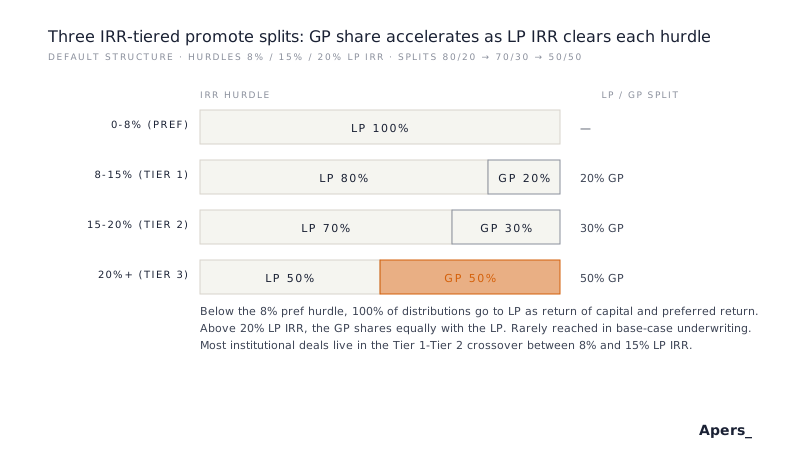
- Three IRR-tiered promote splits (default 80/20 → 70/30 → 50/50 above 8 / 15 / 20 percent LP IRR hurdles) capture the industry-standard promote acceleration. LP-favorable at the bottom, GP-favorable at the top, with the crossover living at the second hurdle where most institutional deals actually clear or fail.
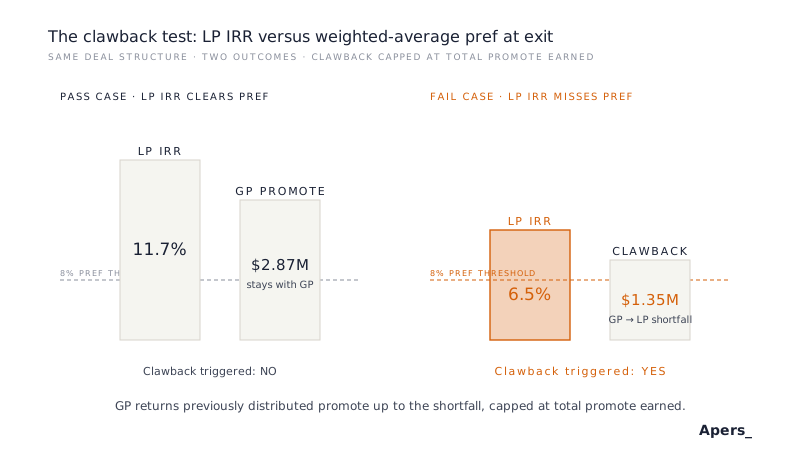
- At-exit clawback tests whether realized LP IRR cleared the commitment-weighted preferred return. If LP IRR fell short, the GP returns previously distributed promote up to the shortfall, capped at the total promote earned. Fires on structural underperformance, not on interim volatility.
- Class toggle architecture: up to three LP classes plus GP, each with an Active Y/N flag. Disabling Class C zeros its commitment, allocations, and IRR without forking the model file. Same workbook serves a two-class Simple deal and a four-class Complex deal.
- CS-001 is annual-period, single-fund, single-exit. No monthly waterfalls, no deal-by-deal promote splits, no multi-vehicle fund-of-funds mechanics, no PIK or paid-in-kind carry variations. The scope traded flexibility for a model that runs on 11 years of cash flow inputs and returns a full per-class return package.
Why a Real Estate Equity Waterfall Is Its Own Model
A real estate equity waterfall is the calculation that turns "the deal made $18M at exit" into "Class A LP receives $6.85M, Class B LP receives $1.96M, and the GP receives $3.87M plus its $1M return of capital." That calculation is neither trivial nor uniform across deals. The waterfall lives in a separate model because bolting it onto a property pro forma either mis-sizes the promote or breaks the property model's inputs.
The reasons waterfalls resist being embedded in a pro forma: the waterfall's cash flow assumptions are orthogonal to the property assumptions (a 7-year hold vs a 10-year hold changes the promote materially but the property pro forma runs the operating cash flow either way); the waterfall's inputs are legal terms (pref rate, hurdles, splits) rather than physical property attributes; and the waterfall's outputs are per-class IRR and equity multiple, which the property pro forma has no way to consume back.
CS-001 is the standalone waterfall model in the Apers Open Model Collection. It takes deal-level cash flow (from any acquisition or development pro forma, or from a fundraising deck) and produces per-class distributions, IRR, equity multiple, and a clawback test. Every design choice below is what makes it a working IC-quality waterfall rather than a spreadsheet approximation.
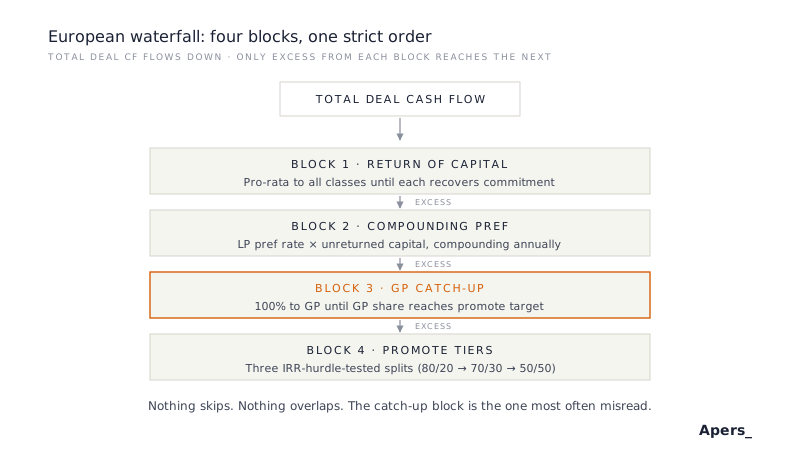
Design Choice: European (Fund-Level) vs American (Deal-by-Deal) Waterfall
CS-001 implements a European-style waterfall. European means the LP has to recover all of its capital across the fund's entire cash flow stream before the GP earns any promote. Deal-by-deal (American) waterfalls compute the promote separately on each investment; the GP can earn carry on a winner even if a subsequent loser drags the aggregate LP return below the pref.
Two reasons the European choice is right for the target user: (1) European is the institutional standard for JV and fund vehicles, where a single sponsor manages a small number of related deals under one LPA and the LP does not want to write a clawback check on Deal 3 to recover promote paid on Deal 1; (2) European is dramatically simpler to model because it operates on aggregated fund cash flow rather than requiring per-deal cost tracking, per-deal exit timing, and per-deal promote sub-accounts.
American-style waterfalls exist and are common in operating-partner deal-by-deal structures. They require different mechanics (per-deal ROC, per-deal pref accrual, per-deal promote crystallization) and a clawback mechanism that tracks realized promote across deals. That is a distinct model architecture, not a mode of CS-001. A shop that needs deal-by-deal promote should model each deal's waterfall separately in a bespoke instance rather than fitting it into an aggregate structure.
Design Choice: Compounding Preferred Return
Preferred return in CS-001 accrues on unreturned LP capital and compounds annually. If Year 1 pref is not fully paid, the shortfall rolls into the Year 2 unpaid-pref balance and earns pref itself in Year 2. This is the industry-standard institutional convention (IRR-based hurdles imply compounding), but it is not universal across smaller-shop or family-office deals, where "simple pref" (pref computed on original capital only, without compounding on unpaid pref) sometimes shows up.
The dollar difference between compounding and simple pref is meaningful in exactly the deals that need the waterfall most: deals where pref is not fully paid current in early years. On a $9M LP contribution at 8 percent pref over a 7-year hold, if the deal pays only $500K per year of pref for the first six years and then a lump at exit, the compounding-pref accrued balance at exit is approximately $370K higher than the simple-pref balance. That $370K becomes real money in the catch-up test and the clawback calculation.
CS-001 hardcodes compounding pref because IRR-based hurdles require it for internal consistency. An IRR hurdle is definitionally a compounding return; testing "did the deal clear 15 percent LP IRR?" against a pref balance computed on simple accrual introduces a mismatch that surfaces as either overpayment of promote or under-triggering of clawback. Users who need simple pref should model it outside CS-001.
Design Choice: The 100 Percent GP Catch-Up Mechanic
Catch-up is the second-most-misunderstood mechanic in a real estate waterfall (after the difference between IRR and equity multiple). It exists to reconcile a mathematical inconsistency between the pref (which pays 100 percent to LP) and the target promote share (which pays some percentage to GP).
Consider a 20 percent GP promote structure. If pref pays 100 percent to LP and promote splits everything above the hurdle 80/20 LP/GP, then the GP's blended share of pref-plus-promote dollars is less than 20 percent (because the pref went entirely to LP and dilutes the GP's take on the totals). To achieve a true 20 percent GP promote share of the pref-plus-catch-up-plus-promote dollars, a catch-up block sits between the pref and the tiered promote splits.
CS-001 implements a full 100 percent GP catch-up. During the catch-up block, 100 percent of available cash goes to the GP until the GP has received an amount equal to the target promote share of the cumulative pref-plus-catch-up distributions. On a 20 percent target promote, the GP catches up to 20 percent of the running total, then the tiered promote splits take over. This makes the GP's blended promote actually equal 20 percent on the eventual distribution mix.
Partial-catch-up structures (50 percent GP catch-up, 80 percent GP catch-up) are common in negotiated JV terms. They slow the GP's acceleration to the promote share and leave more early-year cash with the LP. CS-001 exposes catch-up percentage as an input (default 100 percent) and catch-up target as an input (default 20 percent GP share above pref), so a negotiated 50/20 catch-up is a two-cell change away.
Design Choice: Three IRR-Tiered Promote Splits
Above the catch-up, CS-001 supports three IRR-tiered promote splits with distinct hurdle IRRs and distinct LP/GP splits per tier. The default structure is the industry-standard 80/20 → 70/30 → 50/50 ladder above 8 / 15 / 20 percent LP IRR hurdles. The three tiers exist because a single flat promote split does not reflect how sponsors are actually paid on institutional deals.
- Tier 1: 80/20 LP/GP above 8% LP IRR. The standard "market" promote. Kicks in once the LP has cleared its pref. On a well-underwritten core-plus deal, this is the tier where most of the distribution above pref lives.
- Tier 2: 70/30 LP/GP above 15% LP IRR. The value-add acceleration. Once the deal has cleared a mid-teens IRR to the LP, the GP earns a larger share. Most institutional value-add and opportunistic deals live at the crossover between Tier 1 and Tier 2 at exit.
- Tier 3: 50/50 LP/GP above 20% LP IRR. The upside-case acceleration. On a deal that really outperforms, the GP shares equally in the excess return. Rarely reached in base-case underwriting; matters most in the top-quartile scenarios.
The three-tier structure captures a specific institutional discipline: the GP is compensated modestly for hitting the target, more aggressively for beating the target, and equally with the LP for extreme outperformance. Two-tier structures (80/20 → 50/50) exist but skip the value-add-acceleration middle, which is where the GP-vs-LP alignment conversation actually happens on most deals.
Design Choice: The At-Exit Clawback
Clawback is the mechanism that returns previously-distributed promote to the LP if the realized LP return did not actually clear the preferred return over the full hold. CS-001 tests clawback at exit only, comparing realized LP IRR to the commitment-weighted preferred return across active LP classes. If LP IRR fell short, the GP returns promote up to the shortfall, capped at the total promote earned.
The clawback exists because the tiered promote splits distribute interim cash before the deal has resolved. On a deal that pays $500K of Year-3 promote and then blows up in Year 6, the LP might have received all its capital back but not cleared the 8 percent pref-equivalent future value at exit. In that case, the GP has to return the $500K of Year-3 promote (or as much of it as is needed to make the LP whole on pref).
CS-001 caps the clawback at the total promote earned, not at the GP's contributed capital. A GP that earned $2M of promote across the hold can be clawed back up to $2M but not $3M; if the LP shortfall exceeds cumulative promote, the residual gap is a real loss the LP absorbs. The cap is standard institutional convention and mirrors how a well-drafted LPA actually operates.
Interim clawback tests (year-over-year true-ups rather than exit-only) exist in some private-equity LPAs but are rare in real estate JV structures. CS-001 tests at exit only, which matches the JV and boutique-fund default. Users modeling PE-style interim clawback should overlay a bespoke calculation outside the model.
Design Choice: Class Toggle Architecture
CS-001 supports up to three LP classes plus the GP (four classes total). Each class has an Active Y/N flag: disabling a class zeros its commitment, allocations, and IRR without forking the model. The same workbook serves a simple two-class deal (one LP + GP) and a complex four-class deal (three LP tranches + GP).
The three-LP-class ceiling is a scope decision. Institutional deals with more than three LP tranches exist (fund-of-funds structures, seed-investor tiers, promote-share-carve-outs) but are the tail of the distribution. The 90 percent case is one or two LP classes plus the GP. Adding a fourth or fifth class would double the waterfall's allocation logic without changing the mechanic; the marginal complexity was not worth the marginal coverage.
Per-class pref rates are independent. A deal with a Class A LP at 8 percent pref and a Class B LP at 10 percent pref (Class B is subordinated on downside but earns a higher pref for the risk) is modeled directly. The commitment-weighted pref used in the clawback test respects the per-class rates so a mixed-pref deal's clawback trigger is computed correctly.
What CS-001 Deliberately Leaves Out
The waterfall is a discipline unto itself. CS-001 covers the 80 percent case for JV and boutique-fund real estate deals. Deals outside those boundaries belong in a different model or a bespoke instance.
- No monthly waterfalls. CS-001 operates on annual cash flow inputs (Year 0 through Year 10). Monthly waterfalls exist for interim-liquidity funds and open-ended vehicles but the complexity does not benefit the closed-end JV target audience.
- No deal-by-deal (American) promote. CS-001 is European fund-level only. American waterfalls require per-deal ROC, per-deal pref accrual, per-deal crystallization, and interim clawback tracking that would triple the model size for a different user segment.
- No PIK or paid-in-kind carry variations. Some LPAs allow GP promote to accrue in kind (as additional LP units or partnership interests) rather than in cash. CS-001 distributes only cash.
- No fund-of-funds or multi-vehicle structures. CS-001 models a single fund with a single set of LPs. Feeder-fund structures, parallel funds, and blocker vehicles are out of scope.
- No operating pro forma. CS-001 consumes deal-level cash flow as input but does not generate it. Pair with AQ-131 Multifamily Value-Add Pro Forma, AQ-141 Multifamily Opportunistic Pro Forma, or DV-001 Ground-Up Development for the operating side, then pipe the deal-level cash flow into CS-001 for the waterfall.
- Single exit at end of hold. The model assumes one terminal cash flow event. Recap distributions, partial sales, and hold extensions require the user to model each event as a cash-flow line rather than as a structural feature.
How to Use the Model
CS-001 targets JV structuring, LPA negotiation, fundraising deck construction, and IC memo return analysis. The workflow is three steps.
Step 1: Set the capital structure. On the Inputs sheet, enter one row per class: Active flag, commitment dollars, and per-class pref rate. Toggle inactive classes to N. The model validates that the class percentages sum to 100 percent.
Step 2: Set the waterfall terms. Enter three IRR hurdles (default 8 / 15 / 20 percent), the catch-up percentage and target (default 100 percent to a 20 percent GP share), the three tier splits (default 80/20 → 70/30 → 50/50), and the hold period (1-10 years). The model validates that hurdles are monotonically increasing and that tier splits sum to 100 percent.
Step 3: Pipe in deal-level cash flow. On the Cash Flows sheet, enter Year 0 (negative capital call equal to total commitment) through the exit year in row 6. Years past the hold period should be zeroed. Pull the operating cash flow from whatever pro forma model produced the deal (or type it in for a hypothetical structure).
Then read the Returns sheet for per-class IRR and equity multiple, and the Clawback sheet for the LP pref test. Baseline sanity check on the default inputs ($7M/$2M/$1M capital, 8/15/20 hurdles, 7-year hold, $18M exit in Year 7): Deal IRR ~13.20 percent, LP IRR ~11.70 percent, GP IRR ~22.98 percent, Deal equity multiple ~2.19x, clawback triggered = No.
Related
AQ-131 Multifamily Value-Add Pro Forma,AQ-141 Multifamily Opportunistic Pro Forma,DV-001 Ground-Up Development, andAQ-401 Industrial Warehouse all generate deal-level cash flow at the pre-waterfall stage. Pipe the annual cash flow from any of them into CS-001's Cash Flows sheet to layer the promote analysis on top of the underwriting.
DV-002 Redevelopment / Adaptive Reuse andTX-101 LIHTC Screening are the development-side and tax-credit sources of the same input pattern. Same handoff: their deal-level cash flow becomes CS-001's Row 6 input, and the waterfall computes the per-class returns.
CS-001 does not have a pocket or boutique-tier sibling. A waterfall is inherently structural rather than tiered; a simpler waterfall is not a smaller pocket screener but a bespoke instance of CS-001 with fewer classes active and fewer hurdle tiers configured to zero out. Use the same model, toggle classes and hurdles off.