About This Model
TL;DR
- Industrial warehouse and distribution center underwriting lives at the tenant lease level, not at the blended-rent level. A pro forma that averages rent across a multi-tenant industrial building hides the rollover risk that actually drives the deal.
- AQ-401 tracks up to 10 tenants individually on NNN lease structure: contractual base rent, annual escalation, expiration date, renewal probability, and recovery allocation. Everything else in the model rolls up from those lease abstracts.
- NNN recovery means the tenant pays their pro-rata share of every operating expense line: real estate taxes, insurance, CAM, utilities, management fee. Owner-borne expenses on a fully-NNN industrial building are essentially zero once recovery is applied; the operating expense line exists in the pro forma as a gross-then-recovered pair rather than a net-of-recovery collapse.
- WALT (weighted average lease term) is the central cash-flow risk metric for industrial. A 4.3-year WALT on a 7-year hold means at least one major rollover event lands inside the hold, and that rollover drives the NOI trough year, typically Year 4 or Year 6 depending on which tenant expires.
- TI/LC (tenant improvement and leasing commission) at rollover is modeled as a probability-weighted mix: renewal probability × renewal TI/LC package + (1 − renewal probability) × new-tenant TI/LC package. New leases carry heavier TI (fit-out for a different tenant) than renewals (touch-up).
- Debt sizing uses the standard LTV/DSCR pair, but AQ-401 also surfaces debt yield year-by-year to flag the trough. A perm loan sized to a 10% debt yield floor at Year 1 that dips to 9.49% in the rollover trough year is a covenant risk the underwriter has to disclose to the lender.
- AQ-401 is single-tranche, single-sponsor, single-sale. No GP/LP waterfall, no tax modeling, no construction phasing, no development mode. Each omission traded scope for a model that runs cleanly on lease-level cash flows and reports the metrics an industrial IC actually asks about.
Why Industrial Warehouse Underwriting Is Different from Office or Retail
Industrial warehouse and distribution center underwriting is the acquisition where lease structure determines almost everything about the return. An office building or a stabilized multifamily asset can be underwritten reasonably well on blended-rent-and-blended-vacancy assumptions in the base case; the tenant mix matters at the margin. On a multi-tenant industrial warehouse, the tenant mix is the deal. A 480,000 SF building with an Amazon anchor at 60% of the space and four smaller logistics tenants at 10% each is a completely different asset from a five-way even split among mid-market logistics operators, even at the same NOI.
The three mechanics that make industrial its own underwriting discipline: NNN lease structure that pushes operating expenses onto tenants, weighted-average lease terms (WALT) that concentrate rollover risk into specific years, and TI/LC packages that consume a real fraction of NOI in the years leases turn. A pro forma that treats industrial as "just another commercial acquisition" with blended assumptions mis-sizes at least one of these and usually all three.
AQ-401 is built at the lease level because that is the level at which industrial underwriting actually operates. Every design choice below reflects that resolution.
Design Choice: Tenant-by-Tenant Rent Roll, Not Blended
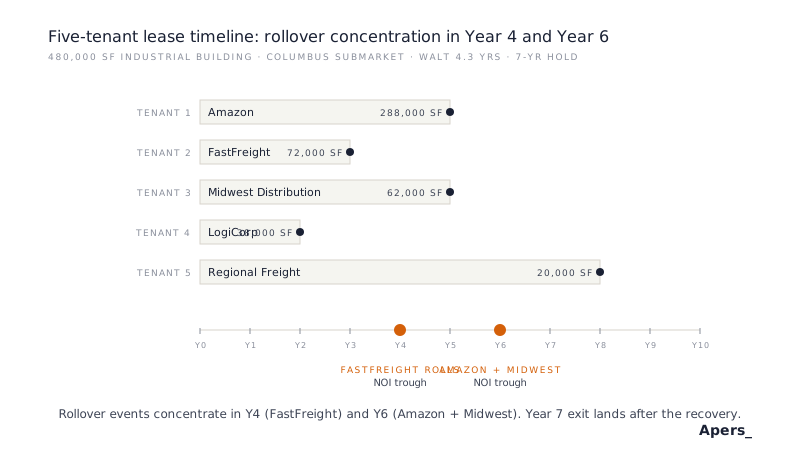
AQ-401 tracks every tenant individually. Amazon at 288,000 SF at $6.75/SF with 2.5% annual escalation is a different revenue stream from FastFreight at 72,000 SF at $7.25/SF with 3.0% annual escalation. Both produce contractual base rent in a given year, but they roll over on different dates, carry different renewal probabilities, and command different TI/LC packages when they turn.
A blended-rent industrial pro forma (weighted-average rent × total SF × vacancy factor) reports approximately the right Year-1 revenue and completely wrong later years. Contract escalations do not move in sync across a multi-tenant rent roll: some leases step 2.5%, some step 3.0%, some step by CPI, some are flat with option-year resets. A blended model that grows the whole rent line at a single escalation rate diverges from actual collectible rent within two or three years of Day 1.
The tenant-level roll-up costs about 20 minutes of input per tenant at underwriting. That is time well spent when a single anchor tenant represents 60% of the revenue and 60% of the rollover risk. It is also the level of detail an institutional lender expects to see in a debt package.
Design Choice: NNN Recovery on Every Line Item
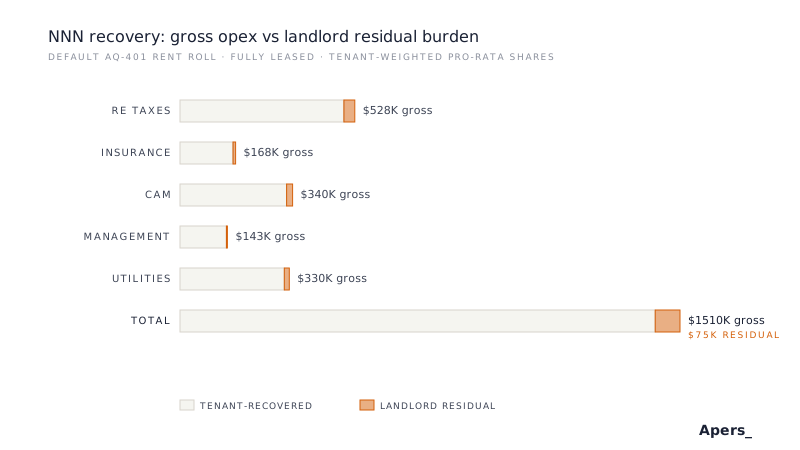
Triple-net (NNN) recovery is the industrial standard. Under NNN, the tenant pays their pro-rata share of every operating expense the landlord incurs: real estate taxes, insurance, common area maintenance (CAM), utilities not separately metered, management fee, landscaping. On a fully-leased NNN industrial building, owner-borne operating expenses are close to zero net of recovery; the operating expense line is essentially a pass-through.
AQ-401 does not collapse this into a net-of-recovery number. It computes gross operating expenses at the line-item level (RE taxes at 1.0% of assessed value, insurance at $0.35/SF, management at 3% of EGI, and so on), then computes tenant recovery at each tenant's pro-rata share, and reports both. The gross OpEx and the recovery both appear in the pro forma, and the NOI reflects gross OpEx minus recovery-adjusted expense (which is the small residual for vacant space and non-recoverable items).
The reason to show both rather than just NOI: recovery mechanics are where lease disputes and audit findings tend to concentrate. A CAM audit that finds landlord over-charged the tenant is a real cash outflow that hits the model as a recovery reversal. Modeling recovery as a separate line lets the underwriter stress it independently.
Design Choice: WALT and the NOI Trough Years
Weighted average lease term (WALT) is the industrial acquisition's most-quoted risk metric. It is computed as the SF-weighted average of remaining lease term across the rent roll: sum of (tenant SF × tenant remaining term in years) divided by total leased SF. On the AQ-401 default rent roll, WALT is 4.3 years across the five-tenant, 480,000 SF building.
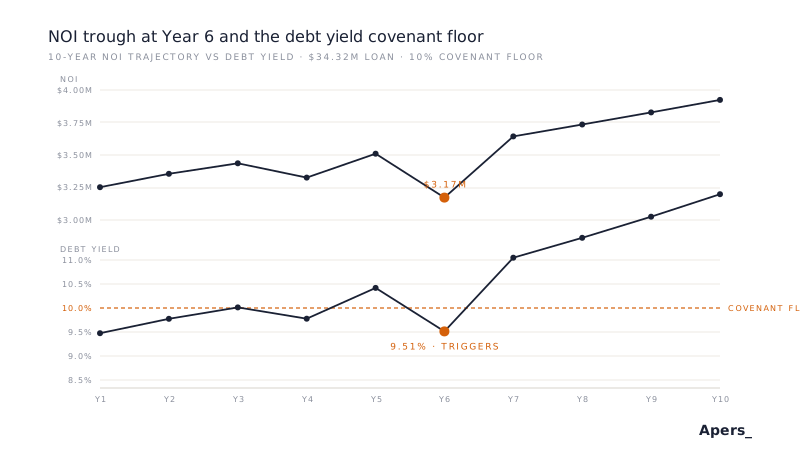
WALT matters for one primary reason: it names the year the underwriter has to survive. On a 7-year hold with a 4.3-year WALT, at least one major rollover event lands inside the hold, and that rollover drives an NOI trough year. On the default AQ-401 deal, Year 4 sees a $327K TI/LC hit from FastFreight rolling over and Year 6 sees a much larger $1.2M hit from Amazon and Midwest rolling over together. Year 6 NOI drops to $3.17M against $3.25M in Year 1 (before the rollover), and Year 7 (the exit year) recovers to $3.64M as the renewed leases come back online.
A stabilized-cash-flow model that averages NOI across the hold understates the trough by definition, and it hides the debt-yield covenant risk that hits in that trough year (covered below). AQ-401 exposes the year-by-year NOI so the underwriter sees the shape of the cash flow before signing the equity check.
Design Choice: TI/LC at Rollover Events
TI (tenant improvement) and LC (leasing commission) are the cash-cost of turning a lease. Every time a lease expires, one of two things happens: the tenant renews, and the landlord pays a smaller renewal TI/LC package to close the deal; or the tenant vacates, and the landlord pays a larger new-tenant TI/LC package to fit out the space for a different user.
AQ-401 models this as a probability-weighted mix at each rollover event. The user sets a renewal probability per tenant (typically 65% for a well-performing industrial tenant, higher for a long-tenured anchor, lower for a mid-market operator on a short remaining term). The model applies: renewal probability × renewal TI/LC + (1 − renewal probability) × new-tenant TI/LC. The result is the expected TI/LC cost at that rollover event.
Renewal TI/LC on the default rent roll runs $2.00/SF (touch-up allowance plus a modest LC to the tenant's broker). New-tenant TI/LC runs $5.00/SF (real fit-out allowance plus a full LC to a procuring broker). For FastFreight's 72,000 SF at 65% renewal probability, that is $2.00 × 72,000 × 0.65 + $5.00 × 72,000 × 0.35 = $93,600 + $126,000 = $219,600, close to the $327K figure the model computes with the layered market-rent step-up assumption on the new-tenant side.
The reason to expose renewal probability as a user input rather than hardcoding it: renewal probability is where the sponsor's tenant relationship shows up in the underwriting. A sponsor who signed the tenant to its current lease and has been managing the building since is not underwriting a 65% renewal; they are underwriting whatever the tenant's expansion or contraction plans actually are. AQ-401 lets that judgment flow into the numbers.
Design Choice: Debt Yield Floor as a Covenant Signal
Industrial debt sizing typically pairs LTV and DSCR constraints (loan to 65% of value, DSCR floor at 1.25x-1.30x). AQ-401 sizes to both. It also surfaces the debt yield metric (NOI divided by loan balance) year-by-year, because industrial lenders increasingly write debt-yield covenants into the loan agreement, and the covenant test hits in the trough year.
On the default AQ-401 deal, the $34.32M loan against Year 1 NOI of $3.25M produces a Year 1 debt yield of 9.48%. That already sits below the typical 10% institutional debt-yield floor, and the Year 6 trough drives it further down to 9.49% against the depressed rollover-year NOI. If the loan carries a 10% debt-yield covenant, the covenant fires in Year 6, and the sponsor either has to cure with a principal paydown or negotiate a waiver.
This is exactly the kind of finding a competent debt package has to disclose to the lender upfront. AQ-401 flags the trough year and the trough debt yield so the underwriter cannot miss it. A pro forma that reports only average-hold DSCR and average-hold debt yield reads clean; a pro forma that reports year-by-year metrics reads honest.
What AQ-401 Deliberately Leaves Out
AQ-401 targets multi-tenant NNN industrial warehouse and distribution center acquisitions. Deals outside those boundaries belong in a different model.
- No GP/LP equity waterfall. AQ-401 returns single-sponsor levered IRR, equity multiple, cash-on-cash, DSCR, and debt yield. Promote and hurdle structures belong in a dedicated waterfall like CS-001 Multi-Class Equity Waterfall, layered on top of the base cash flows.
- No development or construction mode. AQ-401 is an acquisition model. Ground-up industrial development belongs in DV-001 Ground-Up Development, which handles S-curve construction draws and capitalized interest on the build-side.
- No prepayment penalty on early exit. The model exits at Year 7 with a 10-year loan and does not automatically compute yield-maintenance or defeasance. On a $34.32M balance exiting three years early, that can be $300K-$500K of penalty. Sponsors underwriting an intentional early exit should overlay the penalty manually.
- No tax modeling or after-tax returns. Depreciation on industrial buildings is a meaningful driver of after-tax IRR for a taxable sponsor. AQ-401 returns pre-tax metrics only.
- No non-NNN lease structures. The model assumes every tenant is on NNN recovery. Mixed structures (some NNN, some modified gross, some full-service) are out of scope. Mixed-lease commercial should use AQ-301 Anchored Retail Shopping Center or AQ-201 Office Full-Service Lease Rollover depending on asset class.
- Approximated capital reserves. Reserves are flat at $120K/year rather than escalating with expense growth. The impact on IRR is under 5 basis points at typical growth assumptions but should be noted in the underwriting memo.
How to Use the Model
AQ-401 targets IC-ready industrial warehouse and distribution center acquisitions: investment committee memos, JV/LP fundraising packs, lender debt packages, and asset-management underwriting for owned assets. The workflow is four steps.
Step 1: Build the rent roll. One row per tenant. Enter contractual base rent per SF, leased SF, annual escalation rate, lease start and expiration dates, renewal probability, and the renewal / new-tenant TI/LC packages. The model computes WALT and flags concentration risk (any tenant over 30% of GLA triggers a note).
Step 2: Set operating expenses. RE taxes as a percentage of assessed value, insurance as $/SF, CAM and utilities as $/SF, management fee as % of EGI. The model applies NNN recovery at each tenant's pro-rata share and reports gross OpEx, recovery, and net owner burden separately.
Step 3: Size the debt. LTV, interest rate, IO months, amortization schedule, loan term. The model sizes the loan to the LTV/DSCR minimum and surfaces year-by-year DSCR and debt yield. Review the trough year debt yield against the lender's covenant floor.
Step 4: Read the returns. Levered IRR, equity multiple, cash-on-cash, unlevered IRR, stabilized DSCR, trough debt yield, and the NOI trajectory. Cross-check the return against the rollover-year TI/LC hit; if a single trough year drives a disproportionate share of the return variance, the deal is a rollover story that lives or dies on that year's re-leasing execution.
Related
AQ-201 Office Full-Service Lease Rollover is the office analog to AQ-401. Same tenant-by-tenant discipline, but full-service gross (FSG) lease economics with expense stops rather than NNN recovery. Use it when the deal is office rather than industrial.AQ-301 Anchored Retail Shopping Center handles the retail equivalent with four lease-recovery types (NNN, Modified Gross, Base-Year Stop, Gross) and percentage rent. Use it for anchored retail rather than industrial.AQ-111 Multifamily Core Pro Forma is the residential equivalent for stabilized-core underwriting; industrial pros looking at a mixed-asset portfolio can cross-reference the two.DV-001 Ground-Up Development is the development-side model when the industrial deal is a build-to-suit or spec warehouse rather than an existing-asset acquisition. AQ-401 does not handle construction; DV-001 does.