The Rent Roll Is the Model
Underwriting office rollover lease by lease starts with a scenario like this: a 220,000 SF suburban office tower with 38 tenants on the rent roll. The regional bank on floors two and three is 28% of the building and its lease expires in month 42 of your ten-year hold. The law firm on the top floor is 12% and rolls in month 78. In-place rents run from twenty-four to thirty-nine dollars per SF. Market is around thirty-three. The teaser quotes a stabilized cap rate off a rent roll that has not been stabilized in five years.
The deal cannot be underwritten with a blended average. A single-percentage rollover assumption prices the bank rollover the same way it prices the marketing tenant on the mezzanine, and those two events do not move IRR the same way. The pocket-tier office model built for triage gives up this resolution to move fast. The institutional model does not have that option. On a deal like this, the rent roll is the model.
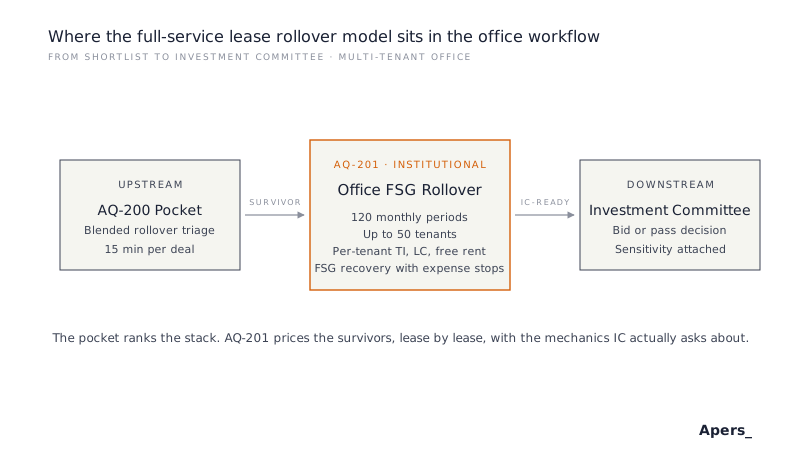
This article walks through the framework a lease-by-lease office model has to implement, then shows how AQ-201, the Apers open full-service office rollover model, operationalizes it on a 120-month monthly grid supporting up to fifty tenants.
What a Blended Rollover Assumption Hides
A blended annual rollover percentage is a defensible triage input. It is a dangerous underwriting input. Two buildings with identical ten-year averages can produce IRRs three hundred basis points apart depending on the shape of the schedule.
The scenario that breaks the average is concentration. When a single tenant is 20% of the building or more, the timing of that one lease drives the deal. A month-42 rollover on your anchor eats twelve months of downtime, forty dollars per SF of TI, and twelve months of free rent at exactly the wrong point in the hold. If the anchor renews, the model prints IC-ready numbers. If it vacates, the same model prints a capital call. A blended assumption reports neither and reports the average of both, which describes no universe the deal actually inhabits.
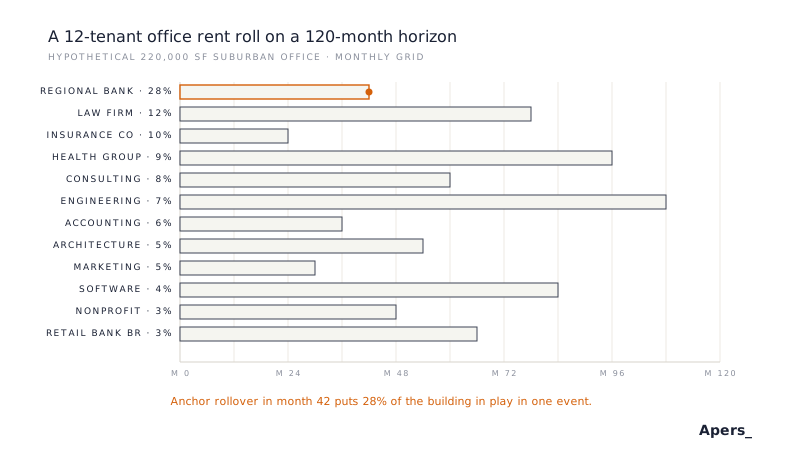
The second scenario the average hides is clustering. A schedule with 34% of the SF rolling in a single year is not the same as 3.4% per year across a decade, even if both average out. Clustering pulls TI and LC forward into a specific fiscal period, changes the debt service coverage calculation for the year the hit lands, and forces a leasing velocity assumption the building may not deliver. A lease-by-lease model reads the schedule directly and lets the cash flow answer.
Full-Service Gross Recovery Mechanics
FSG leases are the dominant structure in institutional office and the primary reason a generic multi-tenant model fails on this asset class. Under FSG, the landlord pays operating expenses from gross rent up to a stated base year. Everything above the base year is billed back to the tenant as an expense stop. That single mechanic changes three things on the cash flow.
First, base rent is not the same as effective rent to the landlord. A new lease with a base year set at current OpEx gives the landlord the full quoted rent for year one and only the incremental expense growth thereafter. The model has to track the base year per lease and roll it forward on renewal or replacement. Second, expense recoveries reset on rollover: when a tenant renews, the base year resets to prevailing OpEx, and the recovery income drops to zero and rebuilds from there. A flat NNN-style recovery assumption misses this event entirely. Third, vacancy is expensive twice: vacant SF earns no rent and generates no recovery, but still incurs its pro-rata share of variable OpEx. A model that zeros only the rent line overstates NOI during downtime.
Probability-Weighted vs. Binary Rollover Logic
Every lease that expires in the hold period faces a fork: the tenant renews or the tenant vacates. Two modes of modeling that decision each have their place, and AQ-201 supports both on a toggle.
Probability-weighted retention assigns each tenant a renewal probability, blends the renewal and vacate cases, and produces a single expected cash flow. It is the right mode for the base case and for a rent roll where thirty tenants roll across the hold and no single lease is load-bearing.
Binary renew-or-vacate resolves the fork explicitly per tenant. The reviewer sets the anchor to vacate and the top two tenants to renew, and the model runs the deterministic consequence. It is the right mode for stress testing and for producing the two numbers the committee actually asks about: what does this deal earn if the bank stays, and what does it earn if the bank leaves. The blended probability answer to that question is not useful for either decision. The two modes answer different questions. A serious underwrite runs both.
TI, LC, and Free Rent on the Same Grid as the Rent
Turnover costs are the reason lease-by-lease matters, and they cannot be modeled as a percentage of rent. New-lease TI packages in a suburban submarket run forty to eighty dollars per SF. Renewal packages run ten to thirty. Leasing commissions run three to six percent on new leases and roughly half that on renewals. Free rent concessions land in the first three to twelve months of a new term. The mechanical requirement is that all three hit the monthly cash flow at the specific month they occur, keyed to the specific lease event that generated them. Folding them into an annualized per-SF average hides the timing that matters for debt service coverage, capital call forecasting, and the actual return.
How AQ-201 Runs the Framework
AQ-201 is the Apers open full-service office rollover model. A rent roll input area supports up to fifty tenants, each with square footage, in-place rent, current base year, lease expiration month, and per-tenant renewal probability. A monthly cash flow grid runs 120 periods and applies base rent, expense-stop recoveries, TI, LC, and free rent on the specific month each lease event triggers them. A toggle switches the retention logic between probability-weighted and binary at the tenant level. A returns block computes levered IRR, equity multiple, cash-on-cash by year, and monthly DSCR.
The model deliberately holds several scope lines. There is no development or ground-up construction logic, because AQ-201 is an acquisition model for an existing rent roll. There is no distribution waterfall, because a waterfall is a separate decision layer that pairs with any underwrite and lives inCS-001 Multi-Class Equity Waterfall. There is no debt sizing engine beyond fixed inputs, because the model prices the deal against quoted or planned terms rather than solving for the debt package. There is no submarket rent forecast module, because submarket rent is an input the reviewer owns.
Each of those omissions traded scope for solvability at the twelve-month build target. Adding a waterfall to the same file would confuse the two calculations. Adding a debt-sizing engine would conflate acquisition underwriting with capitalization structuring. AQ-201 is the acquisition cash flow engine, and it does that one job on a schedule the committee can read.
When You Outgrow the Model
Two conditions push a deal past what AQ-201 can express cleanly. First, if the acquisition is paired with a redevelopment or major repositioning plan (mothballed floors, envelope replacement, tenant displacement for construction), the cash flow now has a capital plan phase that the rollover engine was not designed to carry. Second, if the capital structure has multiple equity classes with a waterfall promote, the returns block returns pre-promote LP-level numbers and needs a separate waterfall to produce sponsor-level economics.
- Repositioning or heavy-lift office: DV-002 Redevelopment / Adaptive Reuse
- Stabilized office with credit tenants: AQ-211 Office Core Pro Forma
- Distribution waterfall on top of any pro forma: CS-001 Multi-Class Equity Waterfall
The handoff to any of the above preserves the rent roll, the debt terms, the expense assumptions, and the FSG base-year discipline. The next model expands the layer AQ-201 held constant (construction phasing, capital structure, or credit-tenant treatment) rather than restating the lease-level economics.
Related Models
AQ-200 Office Lease Rollover Pocket is the pocket-tier sibling. Same asset class, same rollover-first framing, but with a blended-annual abstraction instead of a rent roll. Use AQ-200 to rank eight office teasers in a morning and hand the two survivors to AQ-201 for lease-by-lease underwriting.
AQ-211 Office Core Pro Forma is the adjacent-strategy full model for a stabilized office asset with credit tenants and long weighted average lease terms. When rollover is not the story (WALT above eight years, single or dual investment-grade tenants), the core pro forma's fuller treatment of debt structuring and exit pricing matters more than lease-level retention modeling.
AN-004 Bulk Deal Screening Workbook is the upstream batch tool. When the pipeline is twenty office deals rather than one, AN-004 stacks the pocket outputs horizontally so the reviewer can rank the batch before spending AQ-201 time on any single deal.