The Stabilized Triage Problem
Stabilized multifamily is the deal type where analysts most often over-model. The asset is full, the rent roll is clean, operating expenses are stable, and the seller's broker has already delivered a T-12 that mostly matches the T-3. Nothing structural is broken. The only real question is whether the price lets the desk clear its return hurdle. And yet the reflex, at most shops, is to open a ten-tab pro forma template built for value-add work and spend two days answering a question that has one dominant variable.
The consequence is that the stabilized pipeline moves slower than it should. Speed matters more on core than on any other strategy because the differentiation between bidders is not the business plan. It is the number. A shop that gets a priced verdict back on Thursday beats one that gets there Friday, on the same deal, at the same basis, using the same eight inputs.
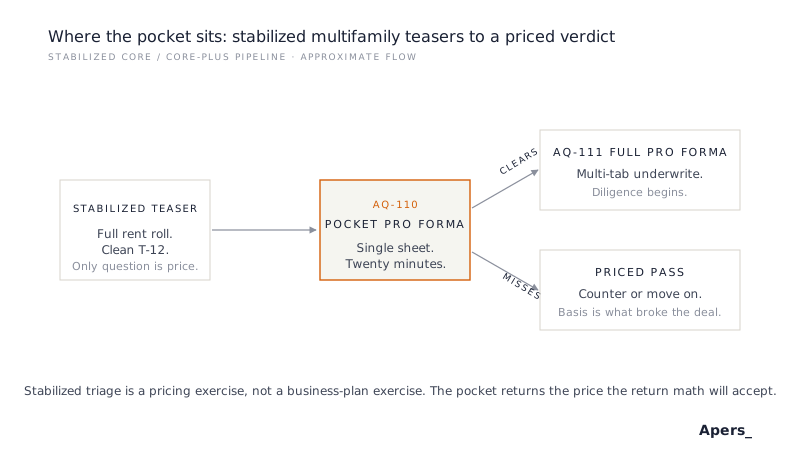
The framework a proper stabilized screener implements is the framework this article walks through. It then shows how AQ-110, the Apers open multifamily core and core-plus pocket model, operationalizes that framework on a single spreadsheet page.
A Pricing Question, Not a Business Plan
The cross-asset screener answers three questions: does the deal clear the return target, does the debt work, does the return survive stress. All three still apply to stabilized multifamily, but the weight shifts. On a stabilized asset the business plan is holding operations flat and letting the market do the work. There is no lease-up curve to model, no unit-turn cadence to schedule, no capex phasing to draw down. The reviewer is not underwriting a plan. The reviewer is pricing a going concern.
That shift lets the screener collapse. The absorption tab, the renovation tab, the tenant-by-tenant rollover tab, the phased capex tab, all of the mechanics that earn their place on a value-add or opportunistic pro forma, are dead weight here. Removing them is not a simplification. It is a scope decision. The stabilized pocket exists because the deal genuinely does not need them, and forcing them into the model creates false precision in cells the analyst has no signal to fill.
Eight Inputs from a Stabilized Teaser
A properly scoped stabilized screener asks for the inputs a broker's core teaser package actually delivers. Eight fields carry the entire underwrite.
- Purchase price. The number the seller is asking. What the model will pressure-test.
- Unit count. The denominator for every per-unit metric used to compare basis against comparable trades in the submarket.
- Average rent per unit. Blended across the unit mix. A stabilized rent roll is stable enough that the blended average is a fair input; per-unit-type detail belongs at the full pro forma stage.
- Annual rent growth. A single scalar applied year over year. Core deals do not carry organic growth stories, so the input is a submarket forecast rather than a unit-turn premium.
- Operating expense ratio. Expenses as a percentage of effective gross income. Stabilized OpEx is a known quantity on the T-12, so the ratio is more useful here than a bottom-up schedule.
- LTV. The proceeds ratio the desk expects on agency, life-company, or bank debt for a stabilized asset in this market.
- Interest rate. The current quoted or indicative rate at the desk's target LTV.
- Exit cap rate. The going-in cap plus a reversion spread, typically twenty-five to fifty basis points on core, wider on core-plus.
The list is deliberately shorter than a cross-asset screener's because a stabilized teaser gives the reviewer more signal per input. The reviewer does not need a market-rent input alongside a current-rent input, because on a stabilized deal the two are the same number.
Five Metrics That Set the Price
Given the eight inputs, the model computes NOI, cash flow after debt, and the five return metrics that carry the pricing verdict.
- Going-in cap rate. Year-one NOI divided by purchase price. For stabilized multifamily this is the most-watched number on the sheet. It is also the number the seller quoted the deal against, so any gap between the reviewer's calculated cap and the marketing cap is a first-order finding.
- Average unlevered yield. The mean of the annual NOI-on-cost figures across the hold. A smoother measure than the going-in cap alone; catches deals where rent growth carries the return.
- Levered IRR. The projected annualized return on equity over the five-year hold, net of the amortizing debt. The primary metric the return target is set against.
- Equity multiple. Total distributions divided by total equity in. The sanity check on the IRR: a five-year IRR at target with a multiple below 1.5x is a deal that survived only because the exit came fast, and the reviewer should treat the IRR with corresponding caution.
- Going-in vs exit cap comparison. The reversion spread expressed as basis points. This is where core deals live or die on assumption discipline.
Reading the Going-In vs Exit Cap
A stabilized deal's return is dominated by two numbers: the price at entry and the price at exit. If the reviewer assumes the deal exits at a tighter cap than it enters, the model is embedding a bet on cap compression, the assumption that most often quietly makes a bad deal look good.
The discipline is to default to a positive reversion spread. Twenty-five to fifty basis points on genuine core, fifty to seventy-five on core-plus with any operational lift in the plan. If clearing the target requires the exit cap to compress, that requirement should show up on the sheet as an explicit assumption, not as an artifact of default settings. The pocket surfaces the delta directly.
How AQ-110 Runs the Framework
AQ-110 is the Apers open pocket model that implements this framework on a single spreadsheet page. Eight inputs across the top of the sheet, a five-year annual projection in the middle, the five return metrics in a results panel, a direct going-in vs exit cap comparison, and a simple two-by-two sensitivity on the two variables that most often move the answer for stabilized deals.
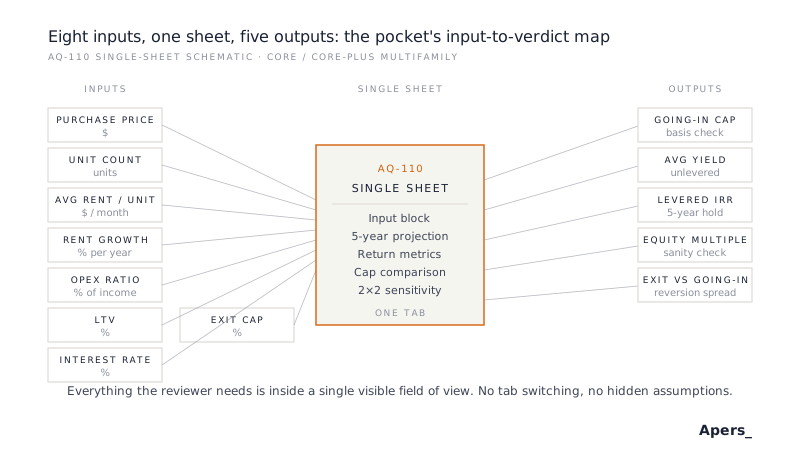
The model deliberately excludes several things a full pro forma would include. No monthly cash flow, because monthly resolution on a stabilized asset with no lease-up curve produces twelve numbers where one is sufficient. No unit-mix breakdown, because the blended rent input already captures the mix and per-unit-type detail belongs at the diligence stage. No distribution waterfall, because a waterfall depends on hold structure the teaser does not specify. No multi-scenario debt sizing, because at the triage stage a single reasonable capital stack answers the pricing question fully.
Each of those omissions traded scope for the ability to give the reviewer a priced answer inside a single visible field of view. Adding any of them would make AQ-110 a slower and less honest tool for the job it exists to do.
When the Pocket Stops Being Enough
A pocket clears a stabilized deal into diligence. It does not clear a deal into investment committee. If the pocket's return metrics survive, the next step is the full pro forma appropriate to the strategy. Pick the model that matches the asset and the business plan:
- Stabilized multifamily, full underwrite: AQ-111 Multifamily Core Pro Forma
- Value-add multifamily with a renovation plan: AQ-131 Multifamily Value-Add Pro Forma
- Opportunistic or heavy-lift multifamily: AQ-141 Multifamily Opportunistic Pro Forma
- Value-add pocket for lighter reposition plays: AQ-130 Multifamily Value-Add Pocket
- Small-balance stabilized deals under fifty units: Small Multifamily Pro Forma
The handoff preserves the pocket's inputs. Purchase price, unit count, blended rent, OpEx ratio, and debt terms all transfer directly. The full pro forma expands the assumptions the pocket held scalar: monthly cash flows replace annual, per-unit-type rents replace the blended average, and a waterfall replaces the single-stack IRR.
Related Models
AQ-111 Multifamily Core Pro Forma is the direct downstream sibling. AQ-110 clears the pricing question; AQ-111 is where the diligence-tier work happens once the deal earns the underwrite. The two models share the same input vocabulary so the handoff is a copy across, not a re-key.
AQ-130 Multifamily Value-Add Pocket is the same-tier, adjacent-strategy sibling. When the teaser has any renovation component or a real mark-to-market rent story, the reviewer should move to AQ-130 rather than force a value-add plan into the stabilized pocket. The two pockets share their reporting layout so the reviewer can compare a core and a value-add teaser on the same visual grid.
AQ-001 Quick Acquisition Screener is the cross-asset generalization of the same triage logic. Use it when the pipeline is mixed and the multifamily-specific inputs in AQ-110 do not carry across the batch. For a multifamily-heavy pipeline, AQ-110 will give a tighter answer because the inputs match the data the teaser actually delivers.