The Triage Problem
Screening commercial real estate deals fast is the load-bearing skill on a working acquisition desk. A typical mid-sized shop sees twenty-five broker teasers a week, and full underwriting on any one of those deals is a two-to-three-day exercise. The math does not work.
The solution every serious shop converges on is a triage layer that sits between the teaser and the full pro forma. Its job is not to underwrite the deal. Its job is to answer a much narrower question: is this deal worth the three days it would take to underwrite it, or does it belong in the pass pile?
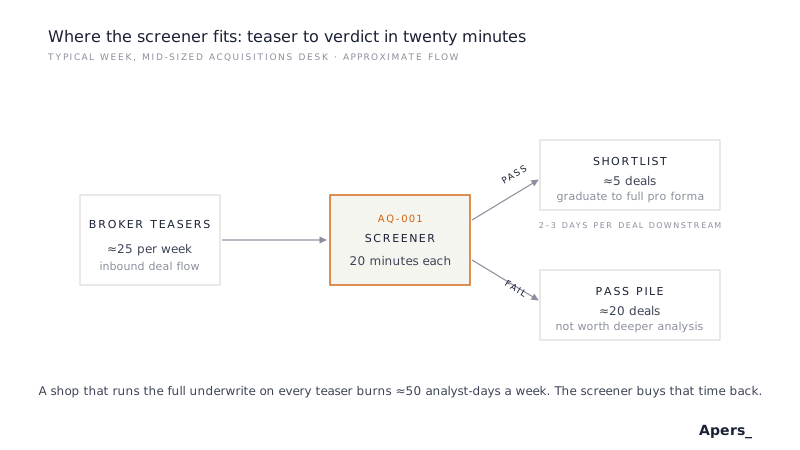
Done well, triage is a twenty-minute exercise per deal. Done badly, it is either a full underwrite in miniature (too slow) or a vibe check on the teaser (too imprecise). This article is about doing it well. It walks through the framework a proper screener implements, then shows how AQ-001, the Apers open acquisition screener, operationalizes that framework on a single spreadsheet page.
The Three Questions a Screener Has to Answer
Every serious triage decision reduces to three questions. A screener that answers fewer than three is incomplete. A screener that tries to answer more than three has become a full pro forma.
- Does the deal clear the desk's return target? Every acquisition group has a target going-in cap rate, a target levered IRR, and a target equity multiple that a deal has to meet to be worth the diligence. A screener has to compute those numbers against reasonable assumptions and compare them to the desk's thresholds.
- Does the debt work? A deal that pencils on an unlevered basis but breaks on the quoted debt terms is a deal that fails at the LP conversation. A screener has to run a debt service coverage check against the current or quoted rate and confirm that the DSCR clears the lender's floor.
- Does the return survive stress? Every set of assumptions in a screener is a guess. If the return only clears the target at the assumed exit cap and the assumed rent growth, the deal is a coin flip that got lucky. A screener has to test the return across a range of the two variables that most often move the answer.
These are the three questions the framework has to answer. Everything else in this article is about how to answer them fast, with the data a teaser actually gives you.
The Seven Inputs a Well-Formed Teaser Gives You
A properly triaged screener asks for the inputs that a legitimate broker teaser contains. Nothing more, because you do not have the data, and nothing less, because the screener cannot answer the three questions without them. In practice that is seven fields.
- Purchase price, plus the unit count for multifamily or the leasable square footage for commercial.
- Current NOI, either trailing-twelve or the broker's stabilized estimate. Either is workable at the screener stage; you will stress this shortly.
- Market rent estimate, from third-party comps, submarket surveys, or the broker's own comp set (treat the last with the appropriate skepticism).
- Basic renovation budget, if the strategy has any value-add component. A single per-unit or per-SF figure is enough at this stage.
- Debt terms: LTV or LTC, interest rate, amortization schedule, interest-only period if any. Use the broker's quoted terms if they appear on the teaser, otherwise use the desk's current defaults.
- Exit cap rate, typically the going-in cap plus twenty-five to seventy-five basis points depending on hold length and strategy.
- Hold period, expressed in years. Five and ten are the standard defaults; a screener that hard-codes to one is not screening business plans correctly.
Any teaser that cannot supply these seven inputs is not a serious offering, and refusing to model past this input filter is itself a triage decision. The screener should make that refusal easy.
The Five Metrics That Decide the Pass/No-Pass Call
Given the seven inputs, five output metrics carry the pass/no-pass verdict on a typical acquisition. A screener that returns fewer is missing a load-bearing check. A screener that returns more is showing off.
- Going-in cap rate. Current NOI divided by purchase price. Every desk quotes deals against its target going-in cap. If the deal is fifty basis points inside your basis, it is probably not for you regardless of the rest of the picture.
- Year-1 cash-on-cash. Levered current yield. Screens for deals where the debt service is eating the return and the deal only works on appreciation.
- Levered IRR. The projected return over the full hold, net of debt. The primary metric for value-add and opportunistic deals; the secondary check for stabilized core.
- Equity multiple. Total cash returned divided by total equity invested. A sanity check on the IRR. Deals with strong IRR but weak multiple are almost always short-hold trades that survive only under aggressive assumptions.
- Debt service coverage ratio. The lender's check that the deal actually pencils against the quoted debt terms. Any screener that skips this ships broken verdicts and misleads the reviewer.
Alongside the five metrics, a proper screener raises flags for the common structural disqualifiers: negative leverage (going-in cap tighter than the debt rate), thin DSCR (below the lender's floor at the quoted rate), inverted exit cap (exit tighter than going-in), and implausible rent growth. A flag does not kill the deal, but it forces the reviewer to state the assumption explicitly before moving forward.
Why Sensitivity Is Not Optional
Every pass/no-pass verdict is really a verdict about assumptions. A deal that pencils at a 5.0% going-in cap on the broker's rent estimate might be a coin flip at 5.4% on a more realistic rent number. A screener that returns a single set of numbers is telling you what the deal looks like in exactly one universe. The universe you are pricing is the range.
The standard sensitivity discipline is a 5x5 matrix on the two variables that most often move the verdict. For a stabilized deal, that is usually exit cap and going-in NOI. For a value-add deal, exit cap and market rent. For a development deal, exit cap and construction cost. The matrix shows the return across five increments of each variable, so the reviewer can see the shape of the return distribution rather than a single point estimate.
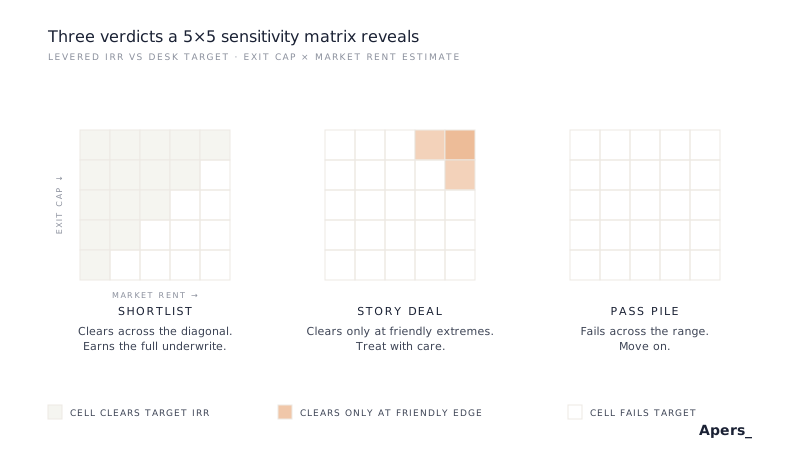
Read the matrix diagonally. If the deal clears the target across the diagonal, it survives realistic stress and earns the full underwrite. If it only clears the target in the top-right corner (the friendliest assumptions), it is a story deal and should be treated as such. If it dies in the middle of the matrix, it dies in the pass pile.
How AQ-001 Runs the Framework
AQ-001 is the Apers open model that implements this framework on a single spreadsheet page. Seven inputs across the top of the sheet, five metrics in the results panel, a flag section for the common disqualifiers, and a 5x5 sensitivity matrix in the bottom-right. Twenty minutes end-to-end for a reviewer who knows the asset class.
The model deliberately excludes several things that a full pro forma would include. There is no monthly cash flow projection, because annual is enough for triage and monthly matters only when you actually stress the lease-up. There is no distribution waterfall, because a waterfall depends on hold structure and cap raise assumptions that a teaser does not specify, and calculating one anyway generates false precision. There is no multi-constraint debt sizing, because teaser-stage debt is quoted terms, not a term sheet, and the specific proceeds figure is provisional either way. There is no tenant-by-tenant lease modeling, because for the twenty-minute triage decision, blended assumptions are sufficient.
Each of those omissions traded scope for solvability at the twenty-minute mark. Adding any of them would make AQ-001 a slower and less honest tool for the triage job. When the deal graduates past screening, the reviewer moves to a full pro forma appropriate to the asset class, and those omitted mechanics are modeled properly there.
When the Screener Stops Being Enough
If a deal survives the screener and clears the flags, the next step is a full underwriting model. Pick the model that matches the asset class and business plan:
- Stabilized multifamily: AQ-111 Multifamily Core Pro Forma
- Value-add multifamily: AQ-131 Multifamily Value-Add Pro Forma
- Opportunistic or heavy-lift multifamily: AQ-141 Multifamily Opportunistic Pro Forma
- Anchored retail centers: AQ-301 Anchored Retail Shopping Center
- Ground-up development: DV-001 Ground-Up Development
The handoff preserves the screener's inputs. Purchase price, unit count, current NOI, debt terms, and exit cap all transfer directly. The full pro forma expands the assumptions the screener held constant (monthly absorption, unit-level rent rolls, phased renovation draws, waterfall promotes) rather than restating the ones already in place.
Related Models
AN-004 Bulk Deal Screening Workbook extends the same triage framework across a batch of teasers on a single horizontal sheet, so a reviewer can rank twenty deals against each other rather than screening one at a time. It is the natural companion to AQ-001 for a desk with high inbound deal flow.
AQ-110 Multifamily Core/Core-Plus Pocket is the asset-specific version of the same screening logic for stabilized multifamily, with unit-level inputs replacing the cross-asset generalization. Use it when the pipeline is multifamily-heavy and the Cross-Asset defaults in AQ-001 stop earning their keep.