About This Model
TL;DR
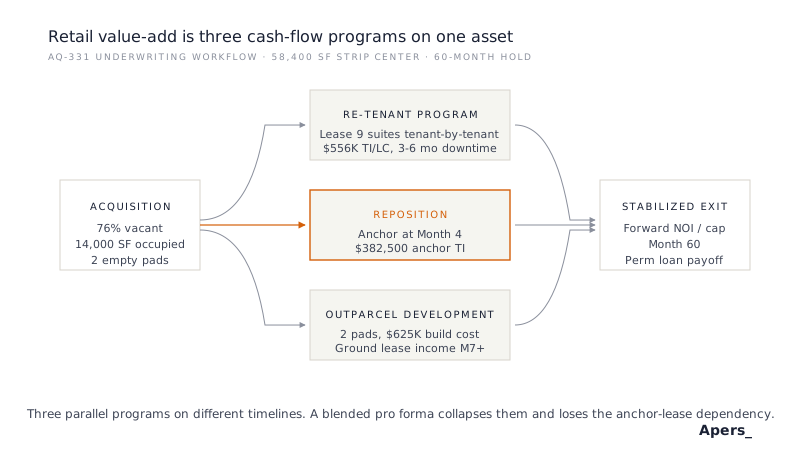
- Retail value-add underwriting on a strip center is three parallel programs on one asset: re-tenanting the vacant inline space, repositioning around a new anchor, and developing the outparcels as ground-leased pads. Each program has its own cadence, its own capital, and its own risk profile. A blended pro forma collapses them and hides the anchor-lease dependency that decides whether the deal works.
- AQ-331 tracks 9 inline suites plus 2 outparcels tenant-by-tenant on NNN economics: contractual base rent per SF, escalation, lease term, downtime, renewal probability, and pro-rata recovery of CAM, insurance, and real estate taxes. Everything above the NOI line rolls up from the lease abstracts, not from a blended-rent assumption.
- Cotenancy provisions and percentage-rent kickers are first-class model inputs. If the anchor goes dark, the junior boxes have contractual rights to reduced rent or termination, and the pro forma has to reflect the contingent revenue hit. Percentage rent above a breakpoint gives landlord a share of tenant sales upside; the mechanic is worth modeling explicitly rather than embedding in a base-rent assumption.
- Outparcel development runs as a second cash flow stream. On the default deal, two pads deploy at Month 6 and Month 9, produce ground-lease income from Month 7 and Month 10, and reprice at exit against a tighter cap rate than the strip-center improvement (5.5% pad vs 7.0% strip). That cap-rate arbitrage is a real source of value creation that a single-stream model would never surface.
- The default deal is capital-structured on a bridge-to-perm stack: 65% LTV bridge at 7.5% IO for the reposition, refinanced at Month 30 into a 65%-stabilized-value permanent loan at 5.5% on 25-year amortization. Bridge IO covers the negative cash-flow months during lease-up; the refi crystallizes the value created and resets the debt service downward.
- Replacement reserves live above the NOI line in AQ-331 as-shipped, which understates NOI by about $20,440/year versus the below-line convention typical for institutional retail. The exit valuation is internally consistent, but analysts comparing this NOI against market cap rates should normalize before benchmarking.
- AQ-331 is single-tranche, single-sponsor, single-sale. No GP/LP waterfall, no tax modeling, no ground-up construction of the base building, no scenario engine. Each omission traded scope for a model that runs on lease-level cash flows and produces the returns an IC actually asks about.
Why Retail Value-Add Is Its Own Underwriting Discipline
Retail value-add underwriting is the acquisition where three cash-flow programs run in parallel on one asset, and the pro forma has to model them at their actual timing rather than blending them into a single revenue line. A stabilized retail shopping center can be underwritten reasonably well on tenant-by-tenant rent roll plus modest annual escalations; the tenant mix is in place and the underwriter's job is mostly to price the rollover risk correctly. A retail value-add strip center is a different exercise. The deal starts at 24% occupancy, needs an anchor lease to close to make the cotenancy math work for the junior boxes, and typically has one or two outparcel pads that produce zero income until the ground lease starts.
The three mechanics that make retail value-add its own discipline: tenant-by-tenant re-tenanting with staggered downtime on nine or more inline suites, anchor-driven cotenancy and percentage-rent provisions that make the junior tenants' cash flow contingent on the anchor's performance, and outparcel development as a parallel cash-flow stream that reprices at exit against a different cap rate than the improvement. A pro forma that treats retail value-add as "an anchored retail deal with a bigger TI budget" mis-sizes at least one of these and usually all three.
AQ-331 is built at the lease level with the outparcel pads on their own timeline because that is the resolution at which retail value-add underwriting actually operates. Every design choice below reflects that resolution.
Design Choice: Tenant-by-Tenant Rent Roll, Suite by Suite
Tenant-by-tenant rollover is the core of retail value-add underwriting. AQ-331 tracks every suite individually across the 60-month hold: the 15,000 SF anchor (A1) at $25/SF base with 5% leasing commission; the 8,000 SF junior anchor (A2) at $22/SF; two junior boxes at 1,600 to 2,400 SF; five inline shops at 1,200 to 2,400 SF; and two outparcel pads at 3,750 and 4,100 SF on ground leases. Each row carries its own lease start month, own downtime assumption (3 months for A1, 4 months for A2, 3 to 6 months for inline suites), own escalation rate, and own renewal probability.
The tenant-by-tenant approach is not aesthetic. It is required because the suites do not roll on the same calendar and do not carry the same economics. On the default AQ-331 rent roll, the occupied SF profile moves from 14,000 SF at Month 1 to 36,000 SF at Month 7 as the re-tenanting program lands new leases, then back down to 28,000 SF at Month 19 as two existing tenants (B4 and A2) hit renewal downtime, then back up to stabilization by Month 22. A blended-occupancy model that averages the hold at, say, 85% occupancy would report Year 1 revenue that never actually exists and would hide the Month 19 revenue dip entirely.
Each new lease also carries its own TI/LC deployment month. The anchor A1's $382,500 TI hits at Month 4, the largest single line item in the capital budget and the driver of the Month 4 net cash flow of negative $383,503. Inline suite TI/LC packages deploy in the month the new tenant takes occupancy, which is downtime plus lease-signing month. Modeling this on a suite-by-suite calendar is the only way to size the equity draw correctly through the reposition period.
Design Choice: Cotenancy Triggers and Percentage-Rent Breakpoints
Cotenancy and percentage rent are two contractual mechanics that show up in retail leases and almost nowhere else, and they are the ones a generic multi-tenant model misses. AQ-331 models both as first-class inputs on the leases where they apply.
Cotenancy is a lease provision that ties junior tenants' rent obligation to the anchor's continued operation. If the anchor A1 goes dark or vacates the premises, the junior boxes typically have a menu of rights: pay reduced rent (often 50% of base or a low fixed rate) until a replacement anchor lands, terminate the lease after a stated cure period of 6 to 12 months, or recover unamortized TI as a co-tenancy cure payment. The junior tenant's decision is not the landlord's to make. The landlord's underwriting has to reflect the contingent revenue loss.
Percentage rent is the second mechanic. Retail leases on inline and junior-box space frequently include a percentage-rent kicker: above a stated sales breakpoint (typically base rent divided by a kicker rate of 5 to 8 percent), the tenant pays base rent plus a percentage of gross sales overage. On a $22/SF base rent with a 6 percent kicker, the natural breakpoint is $22 / 0.06 = $367/SF in sales; sales above that level yield landlord an incremental 6 cents on every dollar. On a strong sales year, percentage rent is a meaningful contribution to NOI; the mechanic is worth modeling explicitly rather than embedding an assumed uplift in the base-rent line.
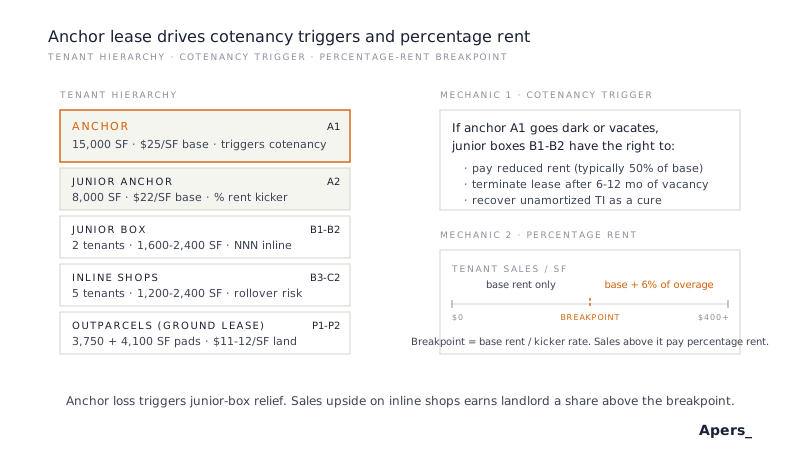
The reason to expose both as inputs rather than hardcoding assumptions: cotenancy exposure and percentage-rent participation are the two levers that make retail value-add underwriting sensitive to the specific lease language on this specific asset, not to a market-average assumption. A deal where the junior boxes have full cotenancy termination rights is a fundamentally different risk from one where they pay reduced rent for 12 months and then continue. A deal with a 6 percent kicker on strong-sales inline is a different upside case from one at 8 percent on weaker volumes. Both live in the lease abstracts; both should live in the pro forma inputs.
Design Choice: Outparcel Development as a Second Cash Flow Stream
Outparcel development is where retail value-add underwriting most often diverges from a strip-center acquisition model. The default AQ-331 deal has two outparcel pads: a 3,750 SF pad that deploys at Month 6 (typically a quick-service restaurant, bank, or medical building) and a 4,100 SF pad that deploys at Month 9. Total pad development cost is $625,000 in the capital budget. Ground-lease income begins the month after each pad is delivered: $3,750/month on Pad 1 from Month 7 ($12/SF on 3,750 SF), $3,758/month on Pad 2 from Month 10 ($11/SF on 4,100 SF).
The pad cash flow is a separate stream from the strip-center improvement. Ground-lease income carries essentially zero operating expense (the tenant owns and operates the pad building; the landlord owns and leases the dirt), so the incremental NOI is close to gross ground rent. At stabilized deployment, the two pads produce about $90,000/year of ground-lease NOI on a $625,000 development cost, a yield-on-cost of roughly 14.4 percent that reprices at exit against a tighter cap rate than the strip center itself.
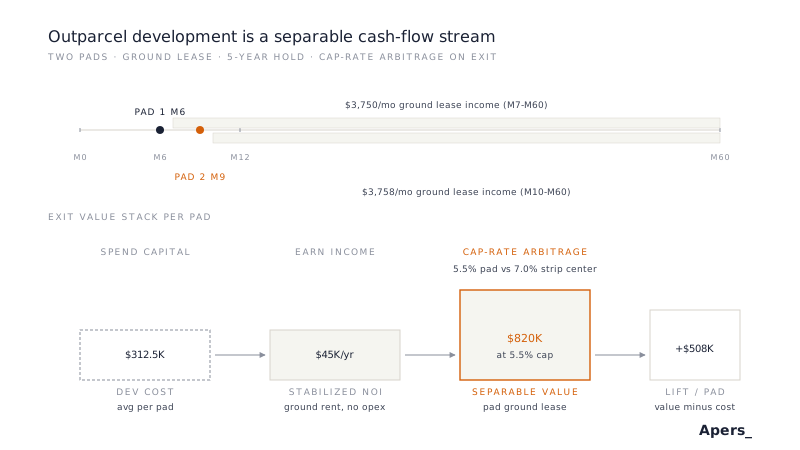
The cap-rate arbitrage is the second layer of value creation on the pads. Institutional pad ground leases trade at meaningfully tighter cap rates than multi-tenant strip centers because the credit tenant (a national QSR, bank, or pharmacy) is investment grade, the lease term is typically 15 to 20 years absolute-NNN with no landlord obligations, and the building reverts to landlord at lease end. At the default 7 percent exit cap on the strip-center improvement and a market 5.5 percent cap on stabilized ground-leased pads, each pad's $45,000/year NOI supports approximately $820,000 of separable exit value on $312,500 of development cost, a lift of roughly $508,000 per pad before disposition costs.
AQ-331 does not automatically bifurcate the exit into pad-separate and strip-center-separate valuations; the shipped model exits the whole asset at a single cap rate. Underwriters intending to market the pads as separate sales at exit should overlay the bifurcated exit manually and compare against the single-cap exit; the delta is a real source of upside that a single-stream model understates.
Design Choice: TI/LC Packages Sized by Tenant Type
TI (tenant improvement) and LC (leasing commission) are the cash cost of turning a lease, and in retail the packages vary widely by tenant type. AQ-331 lets the user set them at the suite level rather than assuming a blanket $/SF number. On the default rent roll, anchor A1 carries $25/SF new TI (a real fit-out for a big-box tenant) plus 5 percent LC on the primary term rent, totaling $382,500 on the 15,000 SF suite. Inline shops carry $15 to $20/SF new TI and 4 to 6 percent LC. Junior boxes fall in between at $12 to $18/SF plus 5 percent LC.
The distinction between renewal TI/LC and new-tenant TI/LC matters and is often understated. A renewal typically carries a touch-up allowance of $5 to $15/SF plus a modest LC (2 to 3 percent on the new term rent) to close the deal with the existing broker. A new tenant carries the full fit-out allowance plus a full new-lease LC (5 to 6 percent) to a procuring broker. On AQ-331's Pizza Palace (2,000 SF, expiring Month 21) and Insurance Co (2,400 SF, expiring Month 30), the shipped model shows $0 TI/LC at renewal, which under-reserves for the renewal transaction cost. A realistic renewal TI of $5/SF on Pizza Palace and $7.50/SF on Insurance Co adds roughly $10,000 and $18,000 respectively at their renewal months, weighted by the 70 percent renewal probability.
AQ-331 deploys TI/LC in the month the tenant takes occupancy. On A1, the anchor takes occupancy at Month 4 after three months of downtime for fit-out; the $382,500 TI hits Month 4 in the capital budget and drives the deep negative cash flow that month. Modeling TI/LC on the calendar (rather than as a Year-1 lump) is what lets the sources-and-uses accurately size the peak equity requirement and the bridge-loan draw schedule.
Design Choice: Bridge-to-Perm Sized for the Stabilization Gap
The default AQ-331 capital stack is a bridge-to-perm structure sized to the stabilization gap. Total uses of $5,542,514 are funded by a $2,730,000 bridge loan (65% LTV at $4.2M purchase, 7.5% interest-only, 36-month term) plus $2,812,514 of equity. At Month 30, the bridge refinances into a permanent loan at $3,412,754 (65% of the stabilized value), interest rate 5.5 percent, 25-year amortization. The refi crystallizes the value created by the re-tenanting and pad-development programs and returns approximately $683,000 of equity back to the sponsor at that event.
Two things about the bridge-to-perm structure are worth naming as design decisions. First, the bridge is interest-only rather than amortizing. During the re-tenanting period, the strip center is producing negative or minimal NOI ($3,454/month negative in Month 1, growing to roughly breakeven by Month 12); an amortizing bridge payment on top of that negative NOI would force the sponsor to fund debt service from equity every month. The IO structure absorbs the reposition period; monthly bridge debt service is $17,062.50, a fixed number the equity draw is sized for.
Second, the refi timing is deliberate. The permanent loan is sized against stabilized value, so the refi cannot happen until stabilization is reached. On the default deal, stabilization is achieved around Month 22 to Month 24 as the last leases roll into place; the refi executes at Month 30 to give lender underwriting a stable 6-month trailing NOI to size against. The bridge is prepaid 6 months early, and the shipped model does not include a prepayment fee. A realistic 1 percent prepayment charge on the $2,730,000 balance is $27,300 of unmodeled cost at Month 30, which the underwriter should overlay when the bridge lender's term sheet requires it.
A parallel design decision: replacement reserves in AQ-331 are modeled above the NOI line at $1,703.33/month ($20,440/year), which understates stated NOI relative to the below-line convention typical for retail. The exit valuation is internally consistent because forward NOI on both sides carries the same reserve treatment, but analysts benchmarking the stabilized cap rate against market comps should normalize by moving reserves below-line. On the default deal, that lifts stabilized NOI from $372,643 to $393,083 and the stabilized cap rate from 8.87% to 9.36%.
What AQ-331 Deliberately Leaves Out
AQ-331 targets multi-tenant retail strip center value-add acquisitions with an anchor re-tenanting play, an inline lease-up program, and outparcel pad development. Deals outside those boundaries belong in a different model.
- No GP/LP equity waterfall. AQ-331 returns single-sponsor levered IRR, equity multiple, cash-on-cash, DSCR, and debt yield. Promote and hurdle structures belong in a dedicated waterfall like CS-001 Multi-Class Equity Waterfall, layered on top of the base cash flows.
- No ground-up construction of the base building. AQ-331 assumes the strip center already exists; the value-add program is re-tenanting, repositioning, and pad development on top of the existing structure. A ground-up retail development belongs inDV-001 Ground-Up Development, which handles S-curve construction draws, capitalized interest, and lease-up absorption from a hard start date.
- No stabilized anchored retail underwriting. AQ-331 targets the value-add case with heavy vacancy and reposition capex. A stabilized anchored retail center with full occupancy at close, three or four recovery-type lease structures, and no repositioning capital belongs in AQ-301 Anchored Retail Shopping Center.
- No prepayment penalty on the bridge. The shipped model retires the bridge at Month 30 against a 36-month term without a prepayment fee or yield maintenance. A realistic 1 percent prepayment on the $2,730,000 balance is $27,300 of unmodeled cost that the underwriter should overlay when the bridge lender's term sheet requires it.
- No tax modeling or after-tax returns. Depreciation on retail improvements and cost-segregation studies materially affect after-tax IRR for a taxable sponsor. AQ-331 returns pre-tax metrics only.
- Deterministic downtime and flat market rent. Downtime per suite is entered as a fixed number of months rather than a probability distribution; market rent per SF is held flat through the hold rather than escalated. Both are underwriting-conservatism decisions that the user can override at the input level.
- Single exit at end of hold. No partial sales, no pad-only sales at stabilization, no recaps, no supplemental financings. Underwriters intending to market the pads separately at exit should overlay a bifurcated exit-value calculation and compare against the single-cap exit the model produces.
How to Use the Model
AQ-331 targets IC-ready retail value-add underwriting: investment committee memos, JV/LP fundraising packs, bridge-lender debt packages, and asset-management underwriting for owned strip-center assets. The workflow is four steps.
Step 1: Build the rent roll suite by suite. One row per inline suite plus one row per outparcel pad. Enter contractual base rent per SF, leased SF, annual escalation, lease start and expiration dates, downtime months per suite, renewal probability, and the renewal / new-tenant TI/LC packages. On leases with cotenancy or percentage-rent provisions, enter the trigger conditions and the breakpoint. The model computes occupied SF monthly and flags any concentration risk.
Step 2: Set operating expenses on a $/SF basis. CAM at $4.50/SF (occupied), insurance at $1.25/SF (GLA), real estate taxes at $2.75/SF (GLA), management fee at 5% of EGI, replacement reserves at $0.35/SF (GLA). The model applies NNN recovery at each tenant's pro-rata share and reports gross OpEx, recovery, and net owner burden separately. Consider normalizing reserves below-NOI if benchmarking the stabilized cap rate against market comps.
Step 3: Set the outparcel development schedule. For each pad, enter total development cost, deploy month, ground-lease start month, ground-lease rent per SF, and lease term. On a two-pad deal, cross-check that deploy months align with the site plan and entitlements calendar; a pad that requires an off-site utility extension or a curb-cut permit typically slips relative to a green-field pad.
Step 4: Size the debt. Bridge LTV, bridge rate, bridge term, refi month, perm LTV against stabilized value, perm rate, perm amortization, perm term. Verify the bridge IO absorbs the negative-NOI reposition period and that the refi month sits after stabilization is achieved on the rent roll. Then read the returns and stress the sensitivity: cap-rate stress at exit, downtime stress on inline suites, cotenancy activation stress on the junior boxes.
A deal that clears the return target only at the friendly-corner assumption pair (tightest exit cap, shortest downtime, 100 percent renewal probability, no cotenancy activation) is a story deal that survives only under optimistic underwriting. Retail value-add underwriting is where the diagonal of the sensitivity table matters most, because the failure modes are correlated: an anchor that struggles to lease up is the same anchor whose absence would trigger junior-box cotenancy relief, which is the same absence that would compress achievable inline market rents.
Related
AQ-301 Anchored Retail Shopping Center is the stabilized-retail sibling to AQ-331. Same tenant-by-tenant rent roll and NNN recovery discipline, but built for a fully-leased asset at close with three or four lease-recovery types and modest lease-up scope. Use it when the deal is stabilized retail rather than a value-add reposition.AQ-300 Retail Shopping Center Pocket is the single-sheet pocket-tier version for pipeline triage. Use it upstream of AQ-331 to quickly test whether a retail teaser is worth a full institutional-grade underwrite.AQ-131 Multifamily Value-Add Pro Forma is the residential analog to AQ-331. Same value-add discipline (renovation program, dual rent roll, IO period sized for the ramp), but on a per-unit basis rather than per-suite. Analysts working on mixed-asset portfolios can cross-reference the two.AQ-141 Multifamily Opportunistic Pro Forma is the heaviest-lift sibling in the value-add family: bridge-to-perm, scenario engine, S-curve absorption, waterfall. Use it as a reference for the bridge-to-perm mechanics that AQ-331 shares.DV-001 Ground-Up Development is the correct model when the retail deal is a build-from-dirt rather than an existing-asset reposition. AQ-331 does not handle ground-up construction of the base building; DV-001 does.